
Monday, November 19, 2007
New Blog Started for My Publications
The new Blog is Named Arya's Corner: Recent Publications aksg.blogspot.com

Tuesday, August 14, 2007
Mitra 1961 Adda on 10th August, 2007
After the adda on 10th August at Brajesh Bhattacharya's residence at Nepal Bhattacharya lane, I sent an email to all members of the Mitra 1961 group. There were some mail earlier about whether we discussed about the 3rd Cricket Test beteen India and England at Oval that was in progress at the time.
_Quote
We had a great adda, talking nostalgically about manythings, about Saraswati Pujas in Mitra School,Abhresh's idiosyncracies, Kallol's getting well, etc,as weel as some politics (about our new ladypresident, West Bengal's present state of affairs,anarchy et al), weather, and, of course a little bitabout cricket. The Oval Test, on that day, had lookedvery promising. I am sure quite a few of us, likeParames and Subhendu, kept watching TV and thrilled tosee the most unlikely century by Kumble. However, Iwas really puzzled to find later on Sunday RahulDravid chickening out and not enforcing the follow on.They may call it a collective decision, but it onlyshowed utter lack of courage on the part of theCaptain. Just think, what would have happened if England lost a few quick wickets at the start of thesecond Innings, like what happened to India, on acloudy day. Indian fast bowlers are definetly betterthan English ones for exploiting the conditions socondicive to swing. But Rahul took a decision (whyblame Borde or Bengsarkar?) that I am sure would nothave been taken by Sourav, had he been in charge. Then the Captain batted like he wanted to make it a draw.What an anti-climax! We let Engand off the hook.
Well, we did not dwell on Cricket long during theadda, but none expected the way our captain tookdecisions and performed two days later. We were, onFriday adda, enjoying ourselves the hospitality ofBrajesh and his wife, and kept talking amongstourselves, reminiscing and often cross talking. It wasa 'bishuddha adda'. There was quite a lot to eat andsome to drink too. It was very nice, and I wishothers who could not make it were there too. Pranabclicked a number of photographs; hopefully he willpost in on the website soon.
I understand another adda is being planned inSeptember, at Narayan's residence in Salt Lake. I dont think I can make it there, but I will surely miss it.I must record my appreciation for the efforts taken byPranab, Brajesh, Subir, Ridra and others for makingthe adda so enjoyable. Thank you all.Arjo
Unqute
_Quote
We had a great adda, talking nostalgically about manythings, about Saraswati Pujas in Mitra School,Abhresh's idiosyncracies, Kallol's getting well, etc,as weel as some politics (about our new ladypresident, West Bengal's present state of affairs,anarchy et al), weather, and, of course a little bitabout cricket. The Oval Test, on that day, had lookedvery promising. I am sure quite a few of us, likeParames and Subhendu, kept watching TV and thrilled tosee the most unlikely century by Kumble. However, Iwas really puzzled to find later on Sunday RahulDravid chickening out and not enforcing the follow on.They may call it a collective decision, but it onlyshowed utter lack of courage on the part of theCaptain. Just think, what would have happened if England lost a few quick wickets at the start of thesecond Innings, like what happened to India, on acloudy day. Indian fast bowlers are definetly betterthan English ones for exploiting the conditions socondicive to swing. But Rahul took a decision (whyblame Borde or Bengsarkar?) that I am sure would nothave been taken by Sourav, had he been in charge. Then the Captain batted like he wanted to make it a draw.What an anti-climax! We let Engand off the hook.
Well, we did not dwell on Cricket long during theadda, but none expected the way our captain tookdecisions and performed two days later. We were, onFriday adda, enjoying ourselves the hospitality ofBrajesh and his wife, and kept talking amongstourselves, reminiscing and often cross talking. It wasa 'bishuddha adda'. There was quite a lot to eat andsome to drink too. It was very nice, and I wishothers who could not make it were there too. Pranabclicked a number of photographs; hopefully he willpost in on the website soon.
I understand another adda is being planned inSeptember, at Narayan's residence in Salt Lake. I dont think I can make it there, but I will surely miss it.I must record my appreciation for the efforts taken byPranab, Brajesh, Subir, Ridra and others for makingthe adda so enjoyable. Thank you all.Arjo
Unqute
Thursday, May 31, 2007
The Expose on BMW case- posted on CNN-IBN website
The expose shows the deep malaise that has enveloped the Indian society at large. If you have money and influence, you can literally "get away with murder". In this particular case, two of the topmost lawyears of Delhi have been shown to collude to save a rich man's brat. If they seem to have been prepared to buy the last remaining witness for Rs 2 crores, I wonder how much was spent to get all the other witness "turn hostile", and how much did the lawyers get as their "fees". And of course, nothing is expected out of this expose ultimately. The defence lawyer will definitely wiggle out of the mess by skillfully exploiting the "loopholes" of the law, and proving the "fabrication" and "inadmissibility' of the "doctored" video evidence. Kulkarni would be called "unreliable" and "blackmailing" so and so, as he is aleady being dubbed by both the two lawyears involved. In a civilised democratic society, the two attorneys would have both got immediate suspension from the bar, and Kulkarni would have been given state protection and later perhaps some kind of commendation. In India today one does not expect either to happen.
Wednesday, May 30, 2007
Comments on a Yahoo Video on Iraq War- Father Sons and Brothers
I watched this heartrending video today on Yahoo 60 Minutes, dated 27 May, 2006. And posted the following comments (no 861 in the comments series)
Quote
This was a moving story, of soldiers going to battle an invisible army, in the name of fighting for the country, for a cause that was clearly based on unsubstantiated allegations created by incometent intelligence agencies. There was no evidence that the perpetrators of 9/11 crime had any link with Iraq or with President Saddam. In fact Saddam was no friend of Al Quaida or Bin Laden, and the US government should have taken Saddam's help to trace out these culprits instead of destroying Iraq to the ground and still let the terrorist group survive and thrive. No soldier from a democratic country can fight for an ideal that has been decisively proved hollow. My heart goes out to the four thosand or so US and British soldiers who have laid down their lives for nothing, and I feel for the two hundred thousand troops that are fighting a war in an alien land, with no winning end in sight, for God knows how long. Iraqis do not want them there; the longer they are there, greater destruction is bound to happen in that country. No wars can be won if the people you are supposed to liberate do not support and collaborate. The American people must pressurise the Bush administration to quickly work out a political and just solution along with all the countries in the region in a time bound manner, get the soldiers back home as soon as possible, and let the Iraqis sort out their own problems. Solve the Palestinian tangle instead to bring peace in that part of the world. And rebuild Iraq and Palestine wih "Marshall Plan" type initiative with all the resource the USA has, in stead of spending it on military weapons and killing of people, both locals (in millions) and Americans (in thousands). Akesji, India
Posted by senguptaarya on Wed, May 30, 2007 7:35 AM ET
Unquote
I also wrote the following comments on reading the CBS News May 30, 2007 story on Bush: Iraqi, Afghan Wars "Our Destiny"
I am sorry, President Bush. At least the Iraq war can not be labeled as a destiny for the United States; it was your doing. It was a war gone into in false pretences - not for saving the American nation against the threat of terrorism from a despotic fanatical regime, but most possibly (history will confirm someday in future !) for ulterior political and imperialistic reasons of a coterie of people who wanted to gain and retain wealth in perpetuity. Pray, ask Bush, why have four thousand loyal American soldiers died and what were the sins of hundreds of thousands of the innocent Iraqi civilians who have been killed in the last four years? Can an American patriot not make a "citizen's arrest" of Bush and ensure his impeachment for the crimes against humanity that he has perpetrated?
Posted by aryaseng at 08:44 AM : May 30, 2007
Quote
This was a moving story, of soldiers going to battle an invisible army, in the name of fighting for the country, for a cause that was clearly based on unsubstantiated allegations created by incometent intelligence agencies. There was no evidence that the perpetrators of 9/11 crime had any link with Iraq or with President Saddam. In fact Saddam was no friend of Al Quaida or Bin Laden, and the US government should have taken Saddam's help to trace out these culprits instead of destroying Iraq to the ground and still let the terrorist group survive and thrive. No soldier from a democratic country can fight for an ideal that has been decisively proved hollow. My heart goes out to the four thosand or so US and British soldiers who have laid down their lives for nothing, and I feel for the two hundred thousand troops that are fighting a war in an alien land, with no winning end in sight, for God knows how long. Iraqis do not want them there; the longer they are there, greater destruction is bound to happen in that country. No wars can be won if the people you are supposed to liberate do not support and collaborate. The American people must pressurise the Bush administration to quickly work out a political and just solution along with all the countries in the region in a time bound manner, get the soldiers back home as soon as possible, and let the Iraqis sort out their own problems. Solve the Palestinian tangle instead to bring peace in that part of the world. And rebuild Iraq and Palestine wih "Marshall Plan" type initiative with all the resource the USA has, in stead of spending it on military weapons and killing of people, both locals (in millions) and Americans (in thousands). Akesji, India
Posted by senguptaarya on Wed, May 30, 2007 7:35 AM ET
Unquote
I also wrote the following comments on reading the CBS News May 30, 2007 story on Bush: Iraqi, Afghan Wars "Our Destiny"
I am sorry, President Bush. At least the Iraq war can not be labeled as a destiny for the United States; it was your doing. It was a war gone into in false pretences - not for saving the American nation against the threat of terrorism from a despotic fanatical regime, but most possibly (history will confirm someday in future !) for ulterior political and imperialistic reasons of a coterie of people who wanted to gain and retain wealth in perpetuity. Pray, ask Bush, why have four thousand loyal American soldiers died and what were the sins of hundreds of thousands of the innocent Iraqi civilians who have been killed in the last four years? Can an American patriot not make a "citizen's arrest" of Bush and ensure his impeachment for the crimes against humanity that he has perpetrated?
Posted by aryaseng at 08:44 AM : May 30, 2007
Wednesday, January 31, 2007
I have not attended to my blog for more than two months. I became busy, number 1, and also was lazy in putting in new thoughts here. In the meantime, Bulbuli and Sambit came from England on their annual sojourn and spent ten days with us in Delhi. We went with them to Orchha and Khajuraho in Madhya Pradesh for a short three day outing, which was very good, though both Rupu and I fell ill afterwards down with viral fever. They returned to UK on 21st January, but we could return to work after about a weeks bed rest. I hope to write a bit on our MP trip later (along with posting of some photos).
Today, however, I plan to paste some other writings of mine about events which need to be remembered. First one is regarding an unfortunate event of road rage that I got involved in the month of November, and the second one is about my visit to WIPRO, one of the top three Tech Service Companies in India. Here they are:
Road Rage & Physical Assault on Friday, the 17th November
It was 7-30 in the evening. I was driving in my Corsa Sail car on the Aurobindo Marg towards Saket. My wife was also with me. We were going to see a film at the PVR Saket. As I was crossing the green traffic light at the Adhchini crossing, two young men in a motorbike (none of them had any helmet on) jumped the light ( coming from the opposite direction) and took a sharp U turn at high speed. The bike came in front of my car, which I stopped by using emergency brakes. The bike slipped and the riders fell down on the road.
I was not driving fast, the speed of my car was only around 25 KM/hour. I am quite sure that the car did not hit the bike, as I did not find any visible marks on the front side of the car later. Anyway, as soon as the event happened I rolled down the window on my side, to find out if there has been any injury to the riders. The driver of the bike simply got up , rushed to my side of the car, and before I could say anything, hit me a number of blows with his right hand fist. With the other hand firmly on the glass widow (so that it could not be rolled up), he used choices of unprintable abusive language, demanded money and continued hitting me. My mouth was filled with blood, one of my teeth broke and my spectacle flew off. I realized that this man was a ruffian, and since no policeman was around, and neither did any other car stop to help me, I somehow managed to drive off. The motor cycle followed me at high speed and again came in front of me and made me to stop at the Press Enclave road crossing. My window was unfortunately still down, and the man came and hit me again and tried to pull me out of my car. My wife was by this time frantic, screaming for help and holding me back so that I am not pulled out. She brought out a 500 rupee note, which I handed over to him from my window. Then I managed to roll up my window , but the man continued to thump on my car glass and bonnet. With the help of a few by standers and fellow vehicle owners, I managed to drive off. I could hear that the bike rider was demanding two thousand rupees. He again followed me on his bike , but after a while he gave up. Thus a terror situation that had lasted for about ten minutes (but seemed to be interminable then) was at last over.
The registration no of the motor bike was noted down by my wife. It was DL3S AY 3572.
_____________________________________________________
VISITING WIPRO – AN EXPERIENCE IN INNOVATION
AND OUTSOURCING (published in IMI Newsletter of January,2007)
Professor Arya Kumar Sengupta*
The email message that I received one morning on a bright and festive day in October was one among some thirty I receive nearly everyday. It originated from one Priya Nambiar, an executive from WIPRO, someone I did not know. Inside there was an invitation to participate in a one day event titled “Executive Briefing on Innovation @ WIPRO” at Bangalore, e-signed by the Chairman of the Company, Azim Premji himself. Soon I got a call on my cell phone from Priya, confirming that invitation which had apparently gone to some twenty Academics and Innovation Leaders (as Priya defined them) from all over India. I was pleasantly surprised, and somewhat elated, that my earlier efforts at IIT Delhi as the Managing Director of its autonomous industry interface organization, the Foundation for Innovation and Technology Transfer (FITT), and the initiator of the Technology Business Incubation Unit (TBIU) there, the first of its kind in an academic institution in India, was recognized in one of the topmost Technology Companies of India and the world. I accepted the invitation, of course.
The event took place in the third week of November, and we were all there at Bangalore as the guests of Azim Premji, all expenses paid. Among the delegates there were Professor D Phatak from IIT Bombay, Professor RK Arora of IIT Delhi, Professor Jajoo of IIM Ahmedabad, Professor Sadagopan of IIIT Bangalore, Professor Rajat Moona from IIT Kanpur, Dr Subramanium, DDG of NIC, Dr Gautam Bose of NIC, SR Balasubramanium from HDFC Bank, Vishnu Varshney, MD of Gujarat Venture Finance and others. It was quite a gathering, representing tons of academic excellence and professional acumen.
_____________
*The author teaches Knowledge Management and Entrepreneurship at IMI and is the Programme Director for the 3 year part-time Post Graduate Programme in Management (PGPM) for working Executives. aksg@imi.edu
_____________
WIPRO, many do not know, is a 60 year old Company. From its humble beginning as a vegetable oil manufacturing company in the 1950s, today it has become one of the world’s leading technology service providers. Its annual revenue in the last fiscal year (2005-06) was more than $ 2.4 billion ( Rs 106 billion), of which the combined IT business accounted for $ 2 b. It ranks as the third largest Tech Tigers of India, behind TCS and Infosys. Among the three, WIPRO has arguably the broadest array of Technology Services to offer, including software programming, tech systems integration, systems management, business process outsourcing, R&D outsourcing, consulting, and hardware product engineering. It employs more than 60,000 people, of which its global tech business accounts for 54000; some 14000 were added in one year last fiscal. Its clientele and technology/business collaborators ranges from some of the biggest names in the world, GM, Hewlett Packard, Microsoft, HSBC, SONY, Royal Dutch Shell, and GE. WIPRO has pioneered a strategy of developing expertise in a wide range of different industries, from banking to retail to manufacturing. It has presence in 45 countries, including sales offices, and centres for BPO, software and hardware development and engineering in 14 countries, all around the world, apart from its vast engineering infrastructure in India. It is ranked 7th amongst the top 100 global outsourcing firms. It is listed in the NYSE. It is truly a Transnational Company of the twenty first century.
The invited delegates of the Executive Briefing Meet at Bangalore were given a glimpse of the WIPRO’s vast and multifarious activity canvas in a succinct yet effective manner. We stayed at the WIPRO Guest House at the Sarjapur campus of the Company, that also housed its corporate office. Early in the morning all of us was driven down to their sprawling Electronic City Campus that had more than 25 office complexes where some 40000 people are engaged in Knowledge work. The ambience there was more like that of an academic or a research institution, ultra-modern, high tech, disciplined and extremely efficient. We were given presentations in the conference room, and taken to some of the research labs, the Talent Transformation facility (for corporate training) and the Global Command Centre, which is the hub of the global technology service delivery activities of WIPRO.
WIPRO began its foray into Information technology in 1980 as a traditional maker of computers , one of the first firms in India, but later diversified into software programming and electronics engineering services on hire. In 1990s, when the global competition forced many western multi-nationals resort to outsourcing their IT and business processes in a big way, WIPRO was one of the first organizations in the third world to come up with the necessary wherewithal to quickly adapt to the requirements of so-called virtual corporation. Though it started with low cost routine software programming service, today WIPRO is one of the most capable tech service outfits. It has over the years developed a strong engineering R&D capability, from designing of semi-conductor chips, to creating real time operating systems, to writing software applications, to designing of user interfaces. WIPRO often plays the role of a product integrator. When “there is a need for somebody for tying together a technology from the US, the manufacturing from China, and, perhaps, intellectual property from Israel, that’s us” At the core of WIPRO’s strategy is the transnational business concept that enjoins the Company to perform various corporate functions and types of work at locations in the world where it can be most efficient. A transnational corporation also must set up infrastructure that facilitates communication and collaboration between the far-flung outposts. A number of Indian Companies have successfully joined this bandwagon; WIPRO is one of the leaders in this game. Yet only about 3% of the $700 billion global IT outsourcing was off-shored to Indian Companies in 2006. The potential for Indian tech companies is huge, and WIPRO can be a good model for many others to follow.
There is little doubt that behind the outstanding success of WIPRO is their slavish dedication to satisfaction (more appropriately, delight) of its customers and collaborators. In recent times, WIPRO’s most abiding proposition has been on Total Outsourcing. It is a long term partnership wherein the technology service provider takes the ownership of sustaining and managing the client’s IT strategy & operation; based on a service level agreement, it is a value optimized way to ensure that the client’s IT transforms its Business. There are a large number of corporate clientele with which WIPRO has such total outsourcing relationship.
The other strongest contributing factor is their obsession with innovation. Indeed, innovation has been a buzzword in WIPRO in almost all its functions from its beginning. Over the years, WIPRO’s innovation journey has covered focus on R&D and market to identifying new business opportunity, to business extension, to business transformation. It has been claimed that WIPRO has been sustaining competitive advantage and consolidating its leadership, primarily because of its thrust on the culture and spirit of innovation, for which there is an established and systematic innovation management process in place. The Innovation Initiative at WIPRO is a grassroots effort, comprising idea generation, idea incubation through to successful execution. At least 5% of the Companies revenue in the 2006 fiscal has been estimated to have come from the innovation pipeline. WIPRO aims to grow to a $ 5 billion company in the next five years, for which it is targeting at achieving breakthrough innovations and a new Quantum Innovation Programme has been launched.
A notable feature in WIPRO’s HR management is its emphasis on skill and knowledge upgradation. Every WIPRO employee undergoes knowledge upgradation training at least 12 days in a year. In the present continuously changing business environment, the thrust of WIPRO is in helping people to transform themselves to a higher level of skill and evolving knowledge in new areas. A large infrastructure has been developed for such purpose, and innovatively, it is called Talent Transformation. Every year WIPRO recruits thousands of young graduates, but interestingly many of them are from the science stream rather than from management or engineering. A training programme of more than three to four months later, consisting of classroom teaching, on the job assignments and boot camp exercises, the new recruits get totally transformed into WIPRO professionals. There is also a Wipro Academy of Software Excellence (WASE), which is more like a university within a company.
A one day exposure to the WIPRO way obviously cannot really do justice to the plethora of activities the Company is engaged in. One is however impressed by the environment of professionalism, innovative spirit and unbounded enthusiasm of the WIPRO combine. The management style in WIPRO is truly expressed by its Value pronouncement, appropriately named the Spirit of WIPRO, which comprise an Intensity to Win (thrust on customer success), Acting with Sensitivity (respect for individual) and Unyielding Integrity (commitment, honesty and fairness in action). Azim Premji, the Chairman of the Company, with whom we spent an hour in the late afternoon, represents the WIPRO spirit.
Reference:
a) Power Point Presentations on Introduction to Wipro (by KS Viswanathan, CEO), Total Outsourcing (by Anand Shankaran, VP Global IT Outsourcing) and Managing Innovation (by Divakaran Mangalnath, CTO)
b) Steve Hamm, Bangalore Tigers, Tata McGraw-Hill, New Delhi, 2006
_______________________________________________________________________
Today, however, I plan to paste some other writings of mine about events which need to be remembered. First one is regarding an unfortunate event of road rage that I got involved in the month of November, and the second one is about my visit to WIPRO, one of the top three Tech Service Companies in India. Here they are:
Road Rage & Physical Assault on Friday, the 17th November
It was 7-30 in the evening. I was driving in my Corsa Sail car on the Aurobindo Marg towards Saket. My wife was also with me. We were going to see a film at the PVR Saket. As I was crossing the green traffic light at the Adhchini crossing, two young men in a motorbike (none of them had any helmet on) jumped the light ( coming from the opposite direction) and took a sharp U turn at high speed. The bike came in front of my car, which I stopped by using emergency brakes. The bike slipped and the riders fell down on the road.
I was not driving fast, the speed of my car was only around 25 KM/hour. I am quite sure that the car did not hit the bike, as I did not find any visible marks on the front side of the car later. Anyway, as soon as the event happened I rolled down the window on my side, to find out if there has been any injury to the riders. The driver of the bike simply got up , rushed to my side of the car, and before I could say anything, hit me a number of blows with his right hand fist. With the other hand firmly on the glass widow (so that it could not be rolled up), he used choices of unprintable abusive language, demanded money and continued hitting me. My mouth was filled with blood, one of my teeth broke and my spectacle flew off. I realized that this man was a ruffian, and since no policeman was around, and neither did any other car stop to help me, I somehow managed to drive off. The motor cycle followed me at high speed and again came in front of me and made me to stop at the Press Enclave road crossing. My window was unfortunately still down, and the man came and hit me again and tried to pull me out of my car. My wife was by this time frantic, screaming for help and holding me back so that I am not pulled out. She brought out a 500 rupee note, which I handed over to him from my window. Then I managed to roll up my window , but the man continued to thump on my car glass and bonnet. With the help of a few by standers and fellow vehicle owners, I managed to drive off. I could hear that the bike rider was demanding two thousand rupees. He again followed me on his bike , but after a while he gave up. Thus a terror situation that had lasted for about ten minutes (but seemed to be interminable then) was at last over.
The registration no of the motor bike was noted down by my wife. It was DL3S AY 3572.
_____________________________________________________
VISITING WIPRO – AN EXPERIENCE IN INNOVATION
AND OUTSOURCING (published in IMI Newsletter of January,2007)
Professor Arya Kumar Sengupta*
The email message that I received one morning on a bright and festive day in October was one among some thirty I receive nearly everyday. It originated from one Priya Nambiar, an executive from WIPRO, someone I did not know. Inside there was an invitation to participate in a one day event titled “Executive Briefing on Innovation @ WIPRO” at Bangalore, e-signed by the Chairman of the Company, Azim Premji himself. Soon I got a call on my cell phone from Priya, confirming that invitation which had apparently gone to some twenty Academics and Innovation Leaders (as Priya defined them) from all over India. I was pleasantly surprised, and somewhat elated, that my earlier efforts at IIT Delhi as the Managing Director of its autonomous industry interface organization, the Foundation for Innovation and Technology Transfer (FITT), and the initiator of the Technology Business Incubation Unit (TBIU) there, the first of its kind in an academic institution in India, was recognized in one of the topmost Technology Companies of India and the world. I accepted the invitation, of course.
The event took place in the third week of November, and we were all there at Bangalore as the guests of Azim Premji, all expenses paid. Among the delegates there were Professor D Phatak from IIT Bombay, Professor RK Arora of IIT Delhi, Professor Jajoo of IIM Ahmedabad, Professor Sadagopan of IIIT Bangalore, Professor Rajat Moona from IIT Kanpur, Dr Subramanium, DDG of NIC, Dr Gautam Bose of NIC, SR Balasubramanium from HDFC Bank, Vishnu Varshney, MD of Gujarat Venture Finance and others. It was quite a gathering, representing tons of academic excellence and professional acumen.
_____________
*The author teaches Knowledge Management and Entrepreneurship at IMI and is the Programme Director for the 3 year part-time Post Graduate Programme in Management (PGPM) for working Executives. aksg@imi.edu
_____________
WIPRO, many do not know, is a 60 year old Company. From its humble beginning as a vegetable oil manufacturing company in the 1950s, today it has become one of the world’s leading technology service providers. Its annual revenue in the last fiscal year (2005-06) was more than $ 2.4 billion ( Rs 106 billion), of which the combined IT business accounted for $ 2 b. It ranks as the third largest Tech Tigers of India, behind TCS and Infosys. Among the three, WIPRO has arguably the broadest array of Technology Services to offer, including software programming, tech systems integration, systems management, business process outsourcing, R&D outsourcing, consulting, and hardware product engineering. It employs more than 60,000 people, of which its global tech business accounts for 54000; some 14000 were added in one year last fiscal. Its clientele and technology/business collaborators ranges from some of the biggest names in the world, GM, Hewlett Packard, Microsoft, HSBC, SONY, Royal Dutch Shell, and GE. WIPRO has pioneered a strategy of developing expertise in a wide range of different industries, from banking to retail to manufacturing. It has presence in 45 countries, including sales offices, and centres for BPO, software and hardware development and engineering in 14 countries, all around the world, apart from its vast engineering infrastructure in India. It is ranked 7th amongst the top 100 global outsourcing firms. It is listed in the NYSE. It is truly a Transnational Company of the twenty first century.
The invited delegates of the Executive Briefing Meet at Bangalore were given a glimpse of the WIPRO’s vast and multifarious activity canvas in a succinct yet effective manner. We stayed at the WIPRO Guest House at the Sarjapur campus of the Company, that also housed its corporate office. Early in the morning all of us was driven down to their sprawling Electronic City Campus that had more than 25 office complexes where some 40000 people are engaged in Knowledge work. The ambience there was more like that of an academic or a research institution, ultra-modern, high tech, disciplined and extremely efficient. We were given presentations in the conference room, and taken to some of the research labs, the Talent Transformation facility (for corporate training) and the Global Command Centre, which is the hub of the global technology service delivery activities of WIPRO.
WIPRO began its foray into Information technology in 1980 as a traditional maker of computers , one of the first firms in India, but later diversified into software programming and electronics engineering services on hire. In 1990s, when the global competition forced many western multi-nationals resort to outsourcing their IT and business processes in a big way, WIPRO was one of the first organizations in the third world to come up with the necessary wherewithal to quickly adapt to the requirements of so-called virtual corporation. Though it started with low cost routine software programming service, today WIPRO is one of the most capable tech service outfits. It has over the years developed a strong engineering R&D capability, from designing of semi-conductor chips, to creating real time operating systems, to writing software applications, to designing of user interfaces. WIPRO often plays the role of a product integrator. When “there is a need for somebody for tying together a technology from the US, the manufacturing from China, and, perhaps, intellectual property from Israel, that’s us” At the core of WIPRO’s strategy is the transnational business concept that enjoins the Company to perform various corporate functions and types of work at locations in the world where it can be most efficient. A transnational corporation also must set up infrastructure that facilitates communication and collaboration between the far-flung outposts. A number of Indian Companies have successfully joined this bandwagon; WIPRO is one of the leaders in this game. Yet only about 3% of the $700 billion global IT outsourcing was off-shored to Indian Companies in 2006. The potential for Indian tech companies is huge, and WIPRO can be a good model for many others to follow.
There is little doubt that behind the outstanding success of WIPRO is their slavish dedication to satisfaction (more appropriately, delight) of its customers and collaborators. In recent times, WIPRO’s most abiding proposition has been on Total Outsourcing. It is a long term partnership wherein the technology service provider takes the ownership of sustaining and managing the client’s IT strategy & operation; based on a service level agreement, it is a value optimized way to ensure that the client’s IT transforms its Business. There are a large number of corporate clientele with which WIPRO has such total outsourcing relationship.
The other strongest contributing factor is their obsession with innovation. Indeed, innovation has been a buzzword in WIPRO in almost all its functions from its beginning. Over the years, WIPRO’s innovation journey has covered focus on R&D and market to identifying new business opportunity, to business extension, to business transformation. It has been claimed that WIPRO has been sustaining competitive advantage and consolidating its leadership, primarily because of its thrust on the culture and spirit of innovation, for which there is an established and systematic innovation management process in place. The Innovation Initiative at WIPRO is a grassroots effort, comprising idea generation, idea incubation through to successful execution. At least 5% of the Companies revenue in the 2006 fiscal has been estimated to have come from the innovation pipeline. WIPRO aims to grow to a $ 5 billion company in the next five years, for which it is targeting at achieving breakthrough innovations and a new Quantum Innovation Programme has been launched.
A notable feature in WIPRO’s HR management is its emphasis on skill and knowledge upgradation. Every WIPRO employee undergoes knowledge upgradation training at least 12 days in a year. In the present continuously changing business environment, the thrust of WIPRO is in helping people to transform themselves to a higher level of skill and evolving knowledge in new areas. A large infrastructure has been developed for such purpose, and innovatively, it is called Talent Transformation. Every year WIPRO recruits thousands of young graduates, but interestingly many of them are from the science stream rather than from management or engineering. A training programme of more than three to four months later, consisting of classroom teaching, on the job assignments and boot camp exercises, the new recruits get totally transformed into WIPRO professionals. There is also a Wipro Academy of Software Excellence (WASE), which is more like a university within a company.
A one day exposure to the WIPRO way obviously cannot really do justice to the plethora of activities the Company is engaged in. One is however impressed by the environment of professionalism, innovative spirit and unbounded enthusiasm of the WIPRO combine. The management style in WIPRO is truly expressed by its Value pronouncement, appropriately named the Spirit of WIPRO, which comprise an Intensity to Win (thrust on customer success), Acting with Sensitivity (respect for individual) and Unyielding Integrity (commitment, honesty and fairness in action). Azim Premji, the Chairman of the Company, with whom we spent an hour in the late afternoon, represents the WIPRO spirit.
Reference:
a) Power Point Presentations on Introduction to Wipro (by KS Viswanathan, CEO), Total Outsourcing (by Anand Shankaran, VP Global IT Outsourcing) and Managing Innovation (by Divakaran Mangalnath, CTO)
b) Steve Hamm, Bangalore Tigers, Tata McGraw-Hill, New Delhi, 2006
_______________________________________________________________________
Wednesday, November 15, 2006
Back at IMI
I feel that I should record some of the developments that took place in IMI after I returned from the holiday in Britain. Firstly, as the Program Director of the 3 year PG programme for working executives (did I mention it earlier? I was given this administrative responsibility since July,2006), I had to identify and persuade a visiting faculty to take a full course on Organisational Behaviour (OB II). I contacted Kanika Bhal of the Management Studies Department of IIT Delhi, and she readily agreed.
Secondly, there was the National Symposium on the Competiveness in Knowledge Economy, that took place at IMI on 3rd and 4th November, 2006. The Symposium proceedings were quite good, and a number of high profile bureaucrats and academics came to present papers. I had one paper on Intellectual Property rights in Knowledge Management. Perhaps I may take up a research project on the subject later on.
I have been invited by IIFT to participate in an EU-India programme and design a curriculum of a course on Technology Transfer. It will be quite a new experience for me, and I am feeling a bit nervous. I have to deliver by the end of January, 2006. I have started to locate some of the earler literature and presentation materials that I had collected during my FITT days, and also looking at some of the other materals on the Internet. Meanwhile, Ashoka Chandra has also asked me to take a 2 session class on Tech Transfer in the PGPM course on Strategic Management of Innovation and Technology (SMIT) in the last week of November. This should help.
On last Monday, ie 13 November, 2006, I went to make a presentation on Coal Industry (why was I asked to do that, by VenkatRatnam, the IMI Director, is bit of a puzzle) at the Employment Summit of the CII. It went off well, and I think it was a good opportunity for networking. Later on the same day I visited the Gurgaon Corporate Office of GENPACT with a few students to attend to a discussion meet on a project on Innovation in an Knowledge Organisation.
Secondly, there was the National Symposium on the Competiveness in Knowledge Economy, that took place at IMI on 3rd and 4th November, 2006. The Symposium proceedings were quite good, and a number of high profile bureaucrats and academics came to present papers. I had one paper on Intellectual Property rights in Knowledge Management. Perhaps I may take up a research project on the subject later on.
I have been invited by IIFT to participate in an EU-India programme and design a curriculum of a course on Technology Transfer. It will be quite a new experience for me, and I am feeling a bit nervous. I have to deliver by the end of January, 2006. I have started to locate some of the earler literature and presentation materials that I had collected during my FITT days, and also looking at some of the other materals on the Internet. Meanwhile, Ashoka Chandra has also asked me to take a 2 session class on Tech Transfer in the PGPM course on Strategic Management of Innovation and Technology (SMIT) in the last week of November. This should help.
On last Monday, ie 13 November, 2006, I went to make a presentation on Coal Industry (why was I asked to do that, by VenkatRatnam, the IMI Director, is bit of a puzzle) at the Employment Summit of the CII. It went off well, and I think it was a good opportunity for networking. Later on the same day I visited the Gurgaon Corporate Office of GENPACT with a few students to attend to a discussion meet on a project on Innovation in an Knowledge Organisation.
Monday, October 16, 2006
A Holiday in Great Britain
Notes: 1. This part of the diary has been written after the event, ie our holidaying in Britain from September 12 to October 5 2006. I started writing on Octber 16, 2006. There are some more photos posted in my new blog akesji1.blogspot.com.
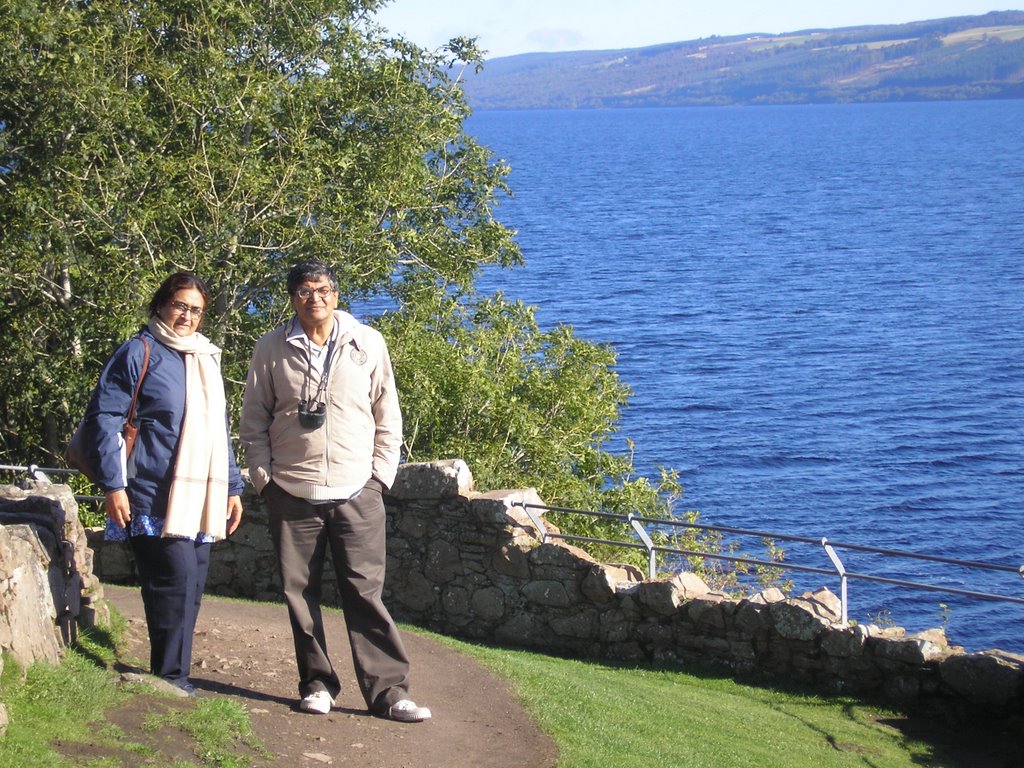
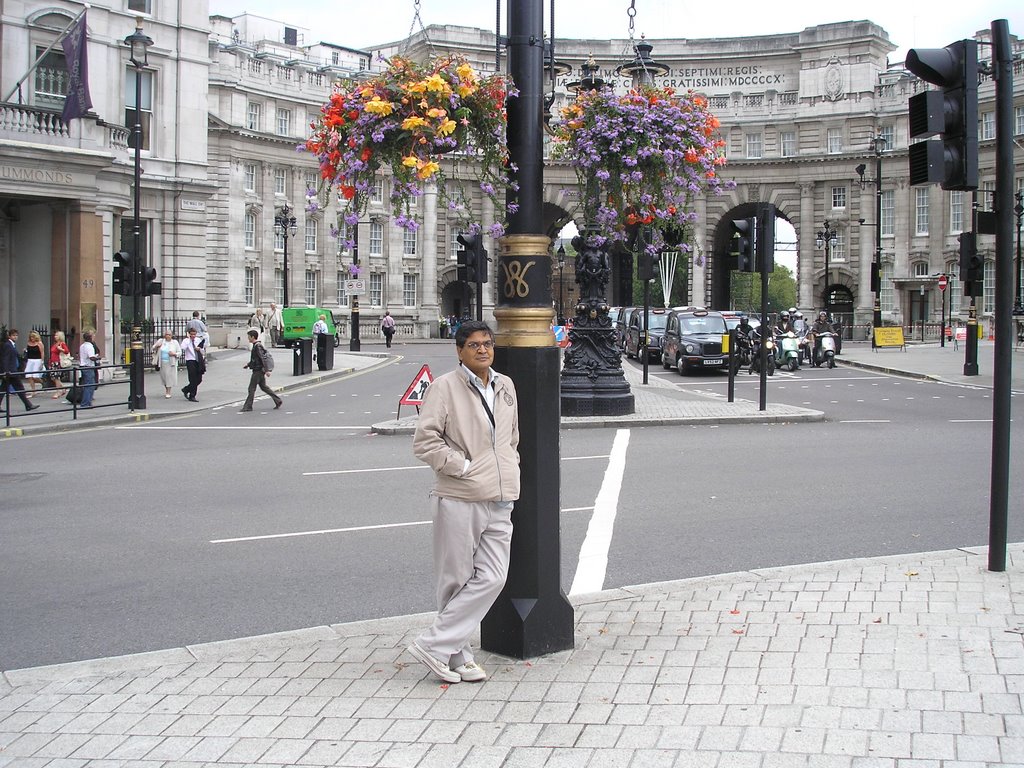
2. We took a large number of photographs on a digital camera. The two above are only samples. The top on is of Rupu and I in the grounds of Urquihert Castle on the Lock Ness in Scotland. The second one was shot in front of the Buckingham Palace at the Trafalgar Square in London.
THE ITINERARY
September 12, 2006 1PM (India Time) ..........Leave Delhi by Virgin Atlatic Airlnes
September 12, 2006 6 PM (UK Time) ............Arrive at Heathrow London
September 12 2006 10PM .............................Arrive at 59, Rodeheath, Luton
September 13 2006 ......................................Whole day relax at home
September 14 2006 11 AM - 12 midnight.......Visiting London by Train
September 15 2006 ......................................Whole day relax at home in Luton
September 16 2006 11 AM- 10pm.................Cambridge in rented car
September 17 2006 11AM - 11pm .................Bath and Stonehenge (by rented car)
September 18 2006 11 am .............................Travel to Nottingham with Ernie Appleton
September 19 2006 9am ...............................Travel to Durham
September 20 2006 ......................................Whole day Durham and New Castle
September 21 2006 3PM ...............................Travel back from Durham and reach Luton
September 22 2006 10Am ............................Drive to Colchester and Flatford by car
September 23 2006 11 AM ............................Drive down to London
September 24 2006 .......................................Played host at Lunch in Luton
September 25 2006 .......................................Relaxed in Luton; visit Luton citycentre
September 26 2006 11 AM ............................Visiting London
September 27 2006 .......................................Resting in Luton Home
September 28 2006 12noon - 3Pm .................In Luton City centre
September 28 2006 8PM ...............................Travel to Edinburgh by air
September 29- October 1 2006 ................Touring Scotland (Edinburgh, Inverness and the Lakes)
October 2 2006 ............................................Relax in Luton
October 3 2006 ............................................Visiting London once more
October 4 2006 .............................................Luton city ventre for shopping
October 5 2006 10PM ...................................Boarded Virgin Atlantic Flight from Heathrow
October 6 2006 11 AM (India Time) ..............Back in Delhi
_____________________________________________
Rupu and I had a hectic holiday in England from September 12th till October 6th. Our primary objective was to spend time with Bulbuli and Sambit at Luton, and at the same time visit a few friends from the past and also go some sight seeing to places in UK where we did not set foot during our previus stay in England. I think we met these objectives to a great extent. My Britsish driving license, which I had acquired in 1978 and which is valid till the year 2015, came handy. On two weekends, we rented cars, three days at a time, and I had a good time driving around Britain to visit Cambridge, Bath, Stonehenge, Colchester, Constable Country, London and so forth. The month of September and the first week of October was to a great extent pleasant. They said that this was the warmest September month in UK in 50 years! It was in fact a bit too warm for comfort. We had carried a lot of warm clothing in our bags, and most of it remained there. Even in Scotland where Sambit and Bulbuli took us for a long weekend between September 28 and October 1, the weather was not much colder. On the whole, however, we had a great time, and it was good fun.
Bulbuli received us at the Heathrow Terminal 3 on Tuesday the September 12 at around 8PM. We had however landed at 6; our Virgin Atlantic Flight from Delhi was on time. Two or three more flights had arrived around the same time. There were about 500 passengers to pass through the immigration control, and less than half of the 40 counters were operating. As a result, we had about two hour to stand in the queue, without any sitting arrangement. Children were crying, old men and women (some must be 80, much older than us) suffered badly. Only those with British, EU or US passports were allowed to pass quickly, whereas almost all the non European passengers were interrogated, some for ten or more minutes. In these days of terrosm and the like, I understand one has to accept some inconvenience, but I could not fathom why more counters were on put to action. Was there a veil impression to be passed on, we prefer Europeans and predominantly white people to visit Britain? Maybe, I am a bit over sensitive, but on that evening the treatment meeted out was not very pleasant, especially when you are visiting a country as tourists.
Anyway, Bulbuli had a taxi hired for us (which charged for an hour or more of extra waiting time). We reached Luton at around 10 PM that night. The flat in Luton was small but comphy, a well appointed two bedroom accommodation. Bulbuli and Sambit graciously gave up the main bedroom for us, while they slept for the next 20 days or so in the living room where they had a spacious Futon sofa-cum bed. Both Bulbuli and Sambit are used to a busy scedule, Bulbuli catches a train to London by 8 in the morning, and Sambit reports to his Hospital by quarter to nine. Rupu and I spent the first day (Wednesday the 13th) relaxing in the flat.
Visiting London- the first day
The next day, Rupu and I ventured out for the first time to go to London. We went to the nearest Rail Station at Leagrave, bought a day ticket to London and back each (which cost a total of 29 pounds) and boarded the 10-59 train of the First Connect Rail Company. In Britain the rail company (the good old British Rail) had been privatised by the Thatcher regime in the eighties, and the result I think has been steep rise in rail fares with little improvement in services (except those that happened due to technological upgradation). We reached the King's Cross at 11-45, and immediate took an underground train (by the Piccadilly Line) to Pimlico, the nearest station for visiting the Tate Gallery, now known as Tate Britain. There is a second Tate Gallery these days, called Tate Modern, which is situated on the other side of the Thames, and one has to cross the river by the new Millenium Bridge at the Black friers. We visited Tate Modern too, but on another day.
We spent more than two hours in the Tate Britain, savouring the paintings by French, Italian, Dutch and British Masters, Renoir, Velasqueze, Da Vinchi, Turner and all. I do admit that I am not a connoisseur of art, but I do enjoy viewing them immensely and wonder about the depth of vision and the sensittivity of the artists. At around 2-30 in the afternoon we came out of the Tate and took another metro ride to the Westminster Bridge. As we came out of the station, there in front of us was London with its full glory, the Big Ben and the Parliament House on one side, and the river Thames on the other, with the huge London Eye or the Millenium Wheel looming large on the opposite bank. We spent a few minutes on the riverside road , taking a few snaps in our digital camera (which had been presented to me by Bulbuli last year when she visited us in Delhi). By now we were quite hungry, so we bought a couple of sandwitches from the shop nearby, and ate them sitting on the portico wall in the Parliament Street. Thereafter we walked on the Whitehall towards the Trafalgar Square. There in the centre stands the Nelson's Column, on one side is the Buckingham Palace gate, and on another side is the National Gallery. It is a remarkable place, the large square was quite full of people, mostly tourists like us, but mainly from Europe and America, definitely cosmploitan - like a meeting place for the people of the world. We also went into the National Gallery and spent an hour or so there.
By this time, it was past six thirty in the evening. We must have walked miles , and we were tired. Bulbuli had arranged to meet us at the Licester Square, about half a mile from the Trafalgar Square. So we went there, waited for her for some time, and Bulbuli arrived. She looked tired too, after a hard day's work in the office, which is very near the Blackfriers Station. We went into a cafe at the Licester Square and had potato chips,burgers and coffee. Then around seven came Sambit, all the way from Luton. Sambit had purchased tickets for a play in the West End, the Mousetrap at the St Martin's Theatre, which was quite nearby. The play has been running there for 45 years, and still the house was nearly full. It was very enjoyable, though at some point in the middle I must have dozed off for a few minutes, so exhasted were we after a full day of galavanting. In Delhi (and in India in general) we do not walk much, and here in London it was a bit too much work on the first day, especially since I dont think we had got over the jet lag fully by then. The play ended at around ten thirty, and it was nearly twelve in the night when we returned to Luton by train from King's Cross.
The next day, understandably, Rupu and I simply stayed put in the Luton Flat, mostly watching TV. The day after was a Saturday. Sambit rented a car (a Nissan Micra sedan) for the weekend and we all set out for Cambridge at around 11 AM. My British License from the student days were still valid ( issued in 1978, and valid till 2015 when I would be 70), so I was the sole driver. Interestingly, Bulbuli appeared in the Theory Test for the driving license in the morning, and naturally passed with flying colours. Sambit had passed the practical tests only a week before, and was still awaiting to receive the license (which he got only the day after we left for India, and promptly purchased a second hand Mercedise A 1 car the day after). I was hoping to drive in England , and my wishes came true.
Even though Sambit did not have a car of his own when we were in Britain, he had already purchased, very thoughtfully, a GPS technology based portable automobile route tracking device called TOM TOM. This was fixed on the vehicles that we rented. It had a video screen and voice warning ststem. With Tom Tom , one does not need to have to depend on road maps while driving. All one has to do, is to enter data on where you are and where you want to go, any where in UK (or in Europe), and Tom Tom would put on the screen the shortest route, and guide you throughout the journey. Later, of course, the device is being utilised in the car that Sambit has bought.
Cambridge Visit
Rupu and I had spent a delightful one and half years in Cambridge in the early eighties. We had a bagful of memories, mostly happy, and a few that caused disappointments. As we reached the residence of Val and Liz in Oxford Road of Cambridge, I was feeling a bit nostalgic. The two ladies took great care of us, and showed around Cambridge- the colleges (Queens, Kings, Trinity, Magdalene) and the city centre. Liz is doing PhD in Education and History and is attached to Magdalene College. We also came to know that she is also an acredited guide of the Cabridge city. So we were in for a treat, going round the colleges and being told about the history and the special stories linked with them. I do not remember whether we had such a tour of Cambridge when we were here. In the evening we had a sumputuous dinner at a local Indian Restaurant, a treat by Val and Liz. We returned to Luton quite late in the night.
Visiting Bath , the City where the Romans lived
Next day (Sunday) we drove down to Bath. the ancient English City near Wales. On the way we had a bad traffic jam, so had to brake our journey at a roadside motel for lunch, and as a result reached Bath fairly late in the afternoon. We parked our car at a multi level car park, and rest of our Bath visit was on foot. The city centre was actually vehicle free, like many other cities in UK, and had the Cathedral and the Roman Bath apart from large buildings of Victorian (or was it Edwardian?) architecture. The Roman Bath is quite a delightful place, with a bigish tank and hot water springs, that has been in operation for two thosand years, from the time when Romans came and settled here. It has ruins of the Roman era, but kept in a museum style. Entry tickets to Roman bath were quite expensive. We also visited the Jane Austin Museum, apparently set up in the house where she lived and wrote some her novels. Tickets there were also quite pricy. However, both Rupu and Bulbuli are avid admirers of Jane Austin, so it was quite an enjoyable visit.
By the time we left Bath it was past five. The sweet voice on Tom Tom advised us that the distance to Stonehenge from Cambridge was only about forty miles, and we should easily reach there by six, before it became dark. However, nither we nor Tom Tom had taken the Sunday evening trafic ( all returning after a weekend travel) into account, and soon we were caugt in a jam or more accurately a long queue of slow moving vehicles. This meant we arrived at Stonehenge after seven in the evening, when it was pretty dark. The place is in the middle of a moor, with no sign of any village around. By the time we were there, the gates to the Stonhenge ground was closed; but one could see the curious gemetric arrangement of huge stone blocks in the fading lights of the evening. These were brought to this place by men thosands of years ago. It was an eerie sight; unfortunately the photographs that I wanted to capture in our digital camera did not come out, as it was too dark. We spent about half an hour there, out of our car, and on the narrow footpath beside the highway with speeding vehicles. We were not the only one, though. There were a few other late latffis, including a group of some twenty students who had come sightseeing from Germany.
Trip to Nottingham, Durham and New Castle-on-Tyne
The next day was a Monday. By nine, as usual both Bulbuli and Sambit, left for work. Ernie Appleton came to our Luton home at around eleven and soon Rupu and I were on our way to Nottingham with him. Ernie drove a Merc A1 sedan, and the drive on the Motorway M1 took us nearly three hours to reach Nottingham. We met Xi Qui (pronounced something lime si-shi), Ernie's Chinese wife. Xi Qui was a faculty member in the Nottingham University's Management School and live there in a quaint little duplex house, that has a small garden at the back. She is a very intense person, and quite knowledgeable; she spoke about her research interest - on 'colonisation of mind' , a concept aparently first coined by Ashis Nandy, a JNU professor. Xi Qui laid out a fairly heavy working lunch, and we spent a few hours in the living roomof Xi Qui's flat at Nottingham, simply talking. In the evening Ernie and Xi Qiu took us out to dinner at an authentic Chinese Restaurant. Afterwards we went to a Motel on the M1, where Rupu and I spent the night.
We had our breakfast in the restaurant in the Motorway Restaurant, and precisely at nine in the morning Ernie arrived to drive us iut to Durham. It took us four hours to reach Ernie's residence in Durham, an ancient town with a river, a 1000 year old cathedral, a university, a castle and a prison. The Cathedral was one of the oldest ones in Europe, and largest. Ernie's house was on a narrow hilly road, and one could see the cathedral and the castle from his bedroom. The University was also very ancient, apparently established even before the Oxford and Cambridge universitie. The Castle and the nearby residential houses have become part of the University. As we walked around the university, the river bank and the city centre, we saw how the ancient architecture merged beutifully with modern buildings (the shops, the theatres, the malls). The forest cover in and around the city and the river added to the charming environment. They have recently built a new cricket stadium, which is known to be the highest Test Match arena in the world. A new luxury hotel has come up in the Lumley Castle, notorious for its resident ghosts. We had coffee in the dungeon coffee shop in that hotel, where Rupu got locked inside the toilet for a few minutes and thought that she had a virtual encounter with the resident spooks.
We spent two nights in Ernie's house in Durham. While on the first evening we had dinner at a downtown restaurant, on the second evening Rupu cooked in Ernie's kitchen fish curry, dal, mixed vegetable and biriyani in the Indian style. Though the numer of Indian restaurants in England have proliferated in the the last twenty years (in fact, curry is now recognised as the most sought after food in UK), Ernie told Rupu after the dinner that it was the best Indian food he had had for years.
On the second day Ernie took us to Gateshead, a new industry township on the banks of the river Tyne, opposite New Castle. This was wherethe office of his incubatee company (Durham Pipelines Technology Limited, or DPT in short) is located. He was an entreprenerial type, ever since I know him from my student days in Salford in the sixties and seventies. His spirit remained with him throughout his career, as a professor in Cambridge and later in Durham. Now that he has formally retired from Durham University Mechanical Engineering Department, he keeps himself very busy in his own Company, that he started a few years ago with some of his research students and friends. Though he continues his academic profession as guides for a few PhD stdents, his primary focus is clearly with his Company, which is doing pretty well. He introduced us to his partners and other colleagues.
September 12, 2006 1PM (India Time) ..........Leave Delhi by Virgin Atlatic Airlnes
September 12, 2006 6 PM (UK Time) ............Arrive at Heathrow London
September 12 2006 10PM .............................Arrive at 59, Rodeheath, Luton
September 13 2006 ......................................Whole day relax at home
September 14 2006 11 AM - 12 midnight.......Visiting London by Train
September 15 2006 ......................................Whole day relax at home in Luton
September 16 2006 11 AM- 10pm.................Cambridge in rented car
September 17 2006 11AM - 11pm .................Bath and Stonehenge (by rented car)
September 18 2006 11 am .............................Travel to Nottingham with Ernie Appleton
September 19 2006 9am ...............................Travel to Durham
September 20 2006 ......................................Whole day Durham and New Castle
September 21 2006 3PM ...............................Travel back from Durham and reach Luton
September 22 2006 10Am ............................Drive to Colchester and Flatford by car
September 23 2006 11 AM ............................Drive down to London
September 24 2006 .......................................Played host at Lunch in Luton
September 25 2006 .......................................Relaxed in Luton; visit Luton citycentre
September 26 2006 11 AM ............................Visiting London
September 27 2006 .......................................Resting in Luton Home
September 28 2006 12noon - 3Pm .................In Luton City centre
September 28 2006 8PM ...............................Travel to Edinburgh by air
September 29- October 1 2006 ................Touring Scotland (Edinburgh, Inverness and the Lakes)
October 2 2006 ............................................Relax in Luton
October 3 2006 ............................................Visiting London once more
October 4 2006 .............................................Luton city ventre for shopping
October 5 2006 10PM ...................................Boarded Virgin Atlantic Flight from Heathrow
October 6 2006 11 AM (India Time) ..............Back in Delhi
_____________________________________________
Rupu and I had a hectic holiday in England from September 12th till October 6th. Our primary objective was to spend time with Bulbuli and Sambit at Luton, and at the same time visit a few friends from the past and also go some sight seeing to places in UK where we did not set foot during our previus stay in England. I think we met these objectives to a great extent. My Britsish driving license, which I had acquired in 1978 and which is valid till the year 2015, came handy. On two weekends, we rented cars, three days at a time, and I had a good time driving around Britain to visit Cambridge, Bath, Stonehenge, Colchester, Constable Country, London and so forth. The month of September and the first week of October was to a great extent pleasant. They said that this was the warmest September month in UK in 50 years! It was in fact a bit too warm for comfort. We had carried a lot of warm clothing in our bags, and most of it remained there. Even in Scotland where Sambit and Bulbuli took us for a long weekend between September 28 and October 1, the weather was not much colder. On the whole, however, we had a great time, and it was good fun.
Bulbuli received us at the Heathrow Terminal 3 on Tuesday the September 12 at around 8PM. We had however landed at 6; our Virgin Atlantic Flight from Delhi was on time. Two or three more flights had arrived around the same time. There were about 500 passengers to pass through the immigration control, and less than half of the 40 counters were operating. As a result, we had about two hour to stand in the queue, without any sitting arrangement. Children were crying, old men and women (some must be 80, much older than us) suffered badly. Only those with British, EU or US passports were allowed to pass quickly, whereas almost all the non European passengers were interrogated, some for ten or more minutes. In these days of terrosm and the like, I understand one has to accept some inconvenience, but I could not fathom why more counters were on put to action. Was there a veil impression to be passed on, we prefer Europeans and predominantly white people to visit Britain? Maybe, I am a bit over sensitive, but on that evening the treatment meeted out was not very pleasant, especially when you are visiting a country as tourists.
Anyway, Bulbuli had a taxi hired for us (which charged for an hour or more of extra waiting time). We reached Luton at around 10 PM that night. The flat in Luton was small but comphy, a well appointed two bedroom accommodation. Bulbuli and Sambit graciously gave up the main bedroom for us, while they slept for the next 20 days or so in the living room where they had a spacious Futon sofa-cum bed. Both Bulbuli and Sambit are used to a busy scedule, Bulbuli catches a train to London by 8 in the morning, and Sambit reports to his Hospital by quarter to nine. Rupu and I spent the first day (Wednesday the 13th) relaxing in the flat.
Visiting London- the first day
The next day, Rupu and I ventured out for the first time to go to London. We went to the nearest Rail Station at Leagrave, bought a day ticket to London and back each (which cost a total of 29 pounds) and boarded the 10-59 train of the First Connect Rail Company. In Britain the rail company (the good old British Rail) had been privatised by the Thatcher regime in the eighties, and the result I think has been steep rise in rail fares with little improvement in services (except those that happened due to technological upgradation). We reached the King's Cross at 11-45, and immediate took an underground train (by the Piccadilly Line) to Pimlico, the nearest station for visiting the Tate Gallery, now known as Tate Britain. There is a second Tate Gallery these days, called Tate Modern, which is situated on the other side of the Thames, and one has to cross the river by the new Millenium Bridge at the Black friers. We visited Tate Modern too, but on another day.
We spent more than two hours in the Tate Britain, savouring the paintings by French, Italian, Dutch and British Masters, Renoir, Velasqueze, Da Vinchi, Turner and all. I do admit that I am not a connoisseur of art, but I do enjoy viewing them immensely and wonder about the depth of vision and the sensittivity of the artists. At around 2-30 in the afternoon we came out of the Tate and took another metro ride to the Westminster Bridge. As we came out of the station, there in front of us was London with its full glory, the Big Ben and the Parliament House on one side, and the river Thames on the other, with the huge London Eye or the Millenium Wheel looming large on the opposite bank. We spent a few minutes on the riverside road , taking a few snaps in our digital camera (which had been presented to me by Bulbuli last year when she visited us in Delhi). By now we were quite hungry, so we bought a couple of sandwitches from the shop nearby, and ate them sitting on the portico wall in the Parliament Street. Thereafter we walked on the Whitehall towards the Trafalgar Square. There in the centre stands the Nelson's Column, on one side is the Buckingham Palace gate, and on another side is the National Gallery. It is a remarkable place, the large square was quite full of people, mostly tourists like us, but mainly from Europe and America, definitely cosmploitan - like a meeting place for the people of the world. We also went into the National Gallery and spent an hour or so there.
By this time, it was past six thirty in the evening. We must have walked miles , and we were tired. Bulbuli had arranged to meet us at the Licester Square, about half a mile from the Trafalgar Square. So we went there, waited for her for some time, and Bulbuli arrived. She looked tired too, after a hard day's work in the office, which is very near the Blackfriers Station. We went into a cafe at the Licester Square and had potato chips,burgers and coffee. Then around seven came Sambit, all the way from Luton. Sambit had purchased tickets for a play in the West End, the Mousetrap at the St Martin's Theatre, which was quite nearby. The play has been running there for 45 years, and still the house was nearly full. It was very enjoyable, though at some point in the middle I must have dozed off for a few minutes, so exhasted were we after a full day of galavanting. In Delhi (and in India in general) we do not walk much, and here in London it was a bit too much work on the first day, especially since I dont think we had got over the jet lag fully by then. The play ended at around ten thirty, and it was nearly twelve in the night when we returned to Luton by train from King's Cross.
The next day, understandably, Rupu and I simply stayed put in the Luton Flat, mostly watching TV. The day after was a Saturday. Sambit rented a car (a Nissan Micra sedan) for the weekend and we all set out for Cambridge at around 11 AM. My British License from the student days were still valid ( issued in 1978, and valid till 2015 when I would be 70), so I was the sole driver. Interestingly, Bulbuli appeared in the Theory Test for the driving license in the morning, and naturally passed with flying colours. Sambit had passed the practical tests only a week before, and was still awaiting to receive the license (which he got only the day after we left for India, and promptly purchased a second hand Mercedise A 1 car the day after). I was hoping to drive in England , and my wishes came true.
Even though Sambit did not have a car of his own when we were in Britain, he had already purchased, very thoughtfully, a GPS technology based portable automobile route tracking device called TOM TOM. This was fixed on the vehicles that we rented. It had a video screen and voice warning ststem. With Tom Tom , one does not need to have to depend on road maps while driving. All one has to do, is to enter data on where you are and where you want to go, any where in UK (or in Europe), and Tom Tom would put on the screen the shortest route, and guide you throughout the journey. Later, of course, the device is being utilised in the car that Sambit has bought.
Cambridge Visit
Rupu and I had spent a delightful one and half years in Cambridge in the early eighties. We had a bagful of memories, mostly happy, and a few that caused disappointments. As we reached the residence of Val and Liz in Oxford Road of Cambridge, I was feeling a bit nostalgic. The two ladies took great care of us, and showed around Cambridge- the colleges (Queens, Kings, Trinity, Magdalene) and the city centre. Liz is doing PhD in Education and History and is attached to Magdalene College. We also came to know that she is also an acredited guide of the Cabridge city. So we were in for a treat, going round the colleges and being told about the history and the special stories linked with them. I do not remember whether we had such a tour of Cambridge when we were here. In the evening we had a sumputuous dinner at a local Indian Restaurant, a treat by Val and Liz. We returned to Luton quite late in the night.
Visiting Bath , the City where the Romans lived
Next day (Sunday) we drove down to Bath. the ancient English City near Wales. On the way we had a bad traffic jam, so had to brake our journey at a roadside motel for lunch, and as a result reached Bath fairly late in the afternoon. We parked our car at a multi level car park, and rest of our Bath visit was on foot. The city centre was actually vehicle free, like many other cities in UK, and had the Cathedral and the Roman Bath apart from large buildings of Victorian (or was it Edwardian?) architecture. The Roman Bath is quite a delightful place, with a bigish tank and hot water springs, that has been in operation for two thosand years, from the time when Romans came and settled here. It has ruins of the Roman era, but kept in a museum style. Entry tickets to Roman bath were quite expensive. We also visited the Jane Austin Museum, apparently set up in the house where she lived and wrote some her novels. Tickets there were also quite pricy. However, both Rupu and Bulbuli are avid admirers of Jane Austin, so it was quite an enjoyable visit.
By the time we left Bath it was past five. The sweet voice on Tom Tom advised us that the distance to Stonehenge from Cambridge was only about forty miles, and we should easily reach there by six, before it became dark. However, nither we nor Tom Tom had taken the Sunday evening trafic ( all returning after a weekend travel) into account, and soon we were caugt in a jam or more accurately a long queue of slow moving vehicles. This meant we arrived at Stonehenge after seven in the evening, when it was pretty dark. The place is in the middle of a moor, with no sign of any village around. By the time we were there, the gates to the Stonhenge ground was closed; but one could see the curious gemetric arrangement of huge stone blocks in the fading lights of the evening. These were brought to this place by men thosands of years ago. It was an eerie sight; unfortunately the photographs that I wanted to capture in our digital camera did not come out, as it was too dark. We spent about half an hour there, out of our car, and on the narrow footpath beside the highway with speeding vehicles. We were not the only one, though. There were a few other late latffis, including a group of some twenty students who had come sightseeing from Germany.
Trip to Nottingham, Durham and New Castle-on-Tyne
The next day was a Monday. By nine, as usual both Bulbuli and Sambit, left for work. Ernie Appleton came to our Luton home at around eleven and soon Rupu and I were on our way to Nottingham with him. Ernie drove a Merc A1 sedan, and the drive on the Motorway M1 took us nearly three hours to reach Nottingham. We met Xi Qui (pronounced something lime si-shi), Ernie's Chinese wife. Xi Qui was a faculty member in the Nottingham University's Management School and live there in a quaint little duplex house, that has a small garden at the back. She is a very intense person, and quite knowledgeable; she spoke about her research interest - on 'colonisation of mind' , a concept aparently first coined by Ashis Nandy, a JNU professor. Xi Qui laid out a fairly heavy working lunch, and we spent a few hours in the living roomof Xi Qui's flat at Nottingham, simply talking. In the evening Ernie and Xi Qiu took us out to dinner at an authentic Chinese Restaurant. Afterwards we went to a Motel on the M1, where Rupu and I spent the night.
We had our breakfast in the restaurant in the Motorway Restaurant, and precisely at nine in the morning Ernie arrived to drive us iut to Durham. It took us four hours to reach Ernie's residence in Durham, an ancient town with a river, a 1000 year old cathedral, a university, a castle and a prison. The Cathedral was one of the oldest ones in Europe, and largest. Ernie's house was on a narrow hilly road, and one could see the cathedral and the castle from his bedroom. The University was also very ancient, apparently established even before the Oxford and Cambridge universitie. The Castle and the nearby residential houses have become part of the University. As we walked around the university, the river bank and the city centre, we saw how the ancient architecture merged beutifully with modern buildings (the shops, the theatres, the malls). The forest cover in and around the city and the river added to the charming environment. They have recently built a new cricket stadium, which is known to be the highest Test Match arena in the world. A new luxury hotel has come up in the Lumley Castle, notorious for its resident ghosts. We had coffee in the dungeon coffee shop in that hotel, where Rupu got locked inside the toilet for a few minutes and thought that she had a virtual encounter with the resident spooks.
We spent two nights in Ernie's house in Durham. While on the first evening we had dinner at a downtown restaurant, on the second evening Rupu cooked in Ernie's kitchen fish curry, dal, mixed vegetable and biriyani in the Indian style. Though the numer of Indian restaurants in England have proliferated in the the last twenty years (in fact, curry is now recognised as the most sought after food in UK), Ernie told Rupu after the dinner that it was the best Indian food he had had for years.
On the second day Ernie took us to Gateshead, a new industry township on the banks of the river Tyne, opposite New Castle. This was wherethe office of his incubatee company (Durham Pipelines Technology Limited, or DPT in short) is located. He was an entreprenerial type, ever since I know him from my student days in Salford in the sixties and seventies. His spirit remained with him throughout his career, as a professor in Cambridge and later in Durham. Now that he has formally retired from Durham University Mechanical Engineering Department, he keeps himself very busy in his own Company, that he started a few years ago with some of his research students and friends. Though he continues his academic profession as guides for a few PhD stdents, his primary focus is clearly with his Company, which is doing pretty well. He introduced us to his partners and other colleagues.
Later we went to the riverside - the new millenium bridge on the Tyne. On the Gateshead side, where only ten years ago there were the old port, a new industrial township has grown, primarily consisting of new high tech and knowledge first generation companies. Near the bridge, a brand new Art Gallery have come up, on the model of Tate Modern of London; also a new architecturally extravagant opera house. We visited the Art Gallery and I was a bit stumped my the modernity/abstratness of most of the exhibits, just like I was in Tate Modern where we went later. Next we crossed the bridge and went upto the city centre of Newcastle, which seemed to have done quite well in mingling modernity with tradition.
Ernie drove us back to Luton on Thursday. It was a fairly long drive from Durham, nearly for four hours. It was extremely nice of him to look after us for the four days, during which he had to take leave from his busy scedule. He remains a dear and close friend, for nearly forty years. So is Val, his estranged wife, who along with her present partner Liz had been to India twice in the last six years (last time was last year, to participate in the wedding celebrations of Bulbuli) and was very hospitable earlier when we had visited Cambridge.
Visiting Relatives in London
We rented a car again on the next day for the weekend, and by around 11 AM we were off to London. Sambit was on duty for the weekend, so Bulbuli, Rupu and I went on this trip. There was quite a traffic jam on the Motorway M1 again (they are building additional lanes), so we were quite late arriving in London. The TOM TOM was a great help, and we reached Hounslow, where Sona ( Rupu's cousin sister Kajaldi's daughter) lives, at about 2-30 pm. Her husband Santanu was in Brussels, but their two children were really dears. They came back from school at around three thirty. Meanwhile we had lunch with Sona, who had cooked a hefty meal of Papda and Chingri fish in Bengali style. It was delicious. Now a days, one gets almost all the Indian food items in the London markets; not like when we were students forty years ago.
At around 5 that afternoon, we started for Croydon to visit Dola (my cousin Chandanda's Daughter) and her family. Somehow inspite of TOM TOM's help, we failed to get on the motorway, and as a result we had to travel through the London, and it was peak traffic time. It took us more than two hours to cover aproximately thirty miles. Dola's husband Bublu works with WIPRO, he is in charge of their London office, which is mainly engaged in Client facing before getting a BPO job which normaly gets executed in India. They have two daughters, one seventeen and the other fifteen years old. We spent some two hours with the family, and I must say, they made a lot of fuss over us. It was very noisy, sometime cacophonic, but one felt really close and welcome. Dola insisted that we have dinner, and we had chicken biriyani, purchased from a nearby Bangladeshi restaurant. By the time we returned to Luton, it was past eleven.
Thursday, August 03, 2006
A letter to Bulbuli
Dear Bulbuli,
I returned to Delhi yesterday from Mumbai, after helpinging Munia settle in her new place at the IGIDR. The Institute is located near Gokuldham in the Goregaon East area of northern Mumbai. It is situated on a hilltop with forrest on one side and new housing estates coming up on the other. The place is rather remote; one needs to walk a kilometer or so to reach the nearest shopping area. It is however quite picturesque and very quiet. I suppose Munia will have to get used to living and studying for the next two years in a serene academic environment. I think it will be a nice change for her, after the hectic last few years in Delhi, with St Stehens College, Artists Unlimited and other busy periods and what not.
Munia has been given a temporary room in the IGIDR Guest House, until she moves into a more permanent accommodation in the hostel (which could as well be the third floor of the Guest House itself). She will share the room with another girl, possibly someone joining the M Phil course, someone who did not arrive till yesterday. She is justifiably a bit nervous and lonesome, especially after the first lecture she attended on Mathematical Economics. She thought the professor was very good, but the subject she fears would be very tough too. We saw a big snake in the college campus, which terrified her, even though the gardener there assured us that there has not been a single case of snake bite ever since the Institute started some fifteen years ago.
Munia has however been very impressed by the overall infrastructure of the place, with technologically advanced class rooms, well stocked library, wi-fi connected computer facilities and so forth. She is quetly gearing up to working hard. There are in all hardly a hundred students in the Institute, including around sixty PhD and M Phil researchers,and some forty faculty members. By the way, our Shovan Roy (Cambridge PhD and Planning Commision employee, remember) has been in IGIDR for the last four years as a visiting Fellow. He stays in a very well appointed quarters in the campus, in the same building where there is a flat for Kirit Parikh, who was the Director of IGIDR until recently. Present Director is Professor Radhakrisha, who is also very well known and an accomplished academician. I spent sometime with Shovan in his apartment wth his wife Sumitra and his two year old son Ananda, and had some breakfast with them. I also went to his office in the research block in the Institute, where Munia came in and met him. In a way, the fact that Shovan is there, makes it a bit of a comfort for us and a little less worried.
I do hope that Munia will be very happy in IGIDR. Already, she told us that she wiil be watching "Padmanadir Majhi" today evening in the Institute film society. Pampa is planning a cousins meet this weekend at Bandra, where Munia will be invited.
I spent time with Deepa, with Lokkhi and also with Babi and Chotoboudi while in Mumbai for three days. Deepa and Swapan will be in Bombay possibly only upto December this year as Swapan retire from UTI Bank. Tutu is contemplating to relocate to the Bahamas in his new shore job in a couple of months. Neil, who came to see me at Lokkhi's place in Andheri East, has got a scholarship to do M Sc in Design Technologies at the Milan University in Italy, so he will be in Mumbai till September only. On the other side, Mitra has sought transfer to Mumbai in her ICRA job. I hear Samir may also move to Mumbai next year. So Munia will have enough relatives to go to on weekends, if she wants to.
I have received Sambit's last mail. The letter seems OK. I shall be meeting the Travel agent early next week to finalise our programme for UK in September/October.
I do not know if you remember that Atkins was the Company where your Bhanudada (Rangan's late husband) used to work at the beginning of his stay in England in early eighties. In those days, some of the top guys in Atkins were Bengalees. It is interesting that they are now planning to return to India in a significant way.
I am writing this long mail from my office at IMI. Time to go home, after picking up your Ma from her office.
So long. with love.
Baba
I returned to Delhi yesterday from Mumbai, after helpinging Munia settle in her new place at the IGIDR. The Institute is located near Gokuldham in the Goregaon East area of northern Mumbai. It is situated on a hilltop with forrest on one side and new housing estates coming up on the other. The place is rather remote; one needs to walk a kilometer or so to reach the nearest shopping area. It is however quite picturesque and very quiet. I suppose Munia will have to get used to living and studying for the next two years in a serene academic environment. I think it will be a nice change for her, after the hectic last few years in Delhi, with St Stehens College, Artists Unlimited and other busy periods and what not.
Munia has been given a temporary room in the IGIDR Guest House, until she moves into a more permanent accommodation in the hostel (which could as well be the third floor of the Guest House itself). She will share the room with another girl, possibly someone joining the M Phil course, someone who did not arrive till yesterday. She is justifiably a bit nervous and lonesome, especially after the first lecture she attended on Mathematical Economics. She thought the professor was very good, but the subject she fears would be very tough too. We saw a big snake in the college campus, which terrified her, even though the gardener there assured us that there has not been a single case of snake bite ever since the Institute started some fifteen years ago.
Munia has however been very impressed by the overall infrastructure of the place, with technologically advanced class rooms, well stocked library, wi-fi connected computer facilities and so forth. She is quetly gearing up to working hard. There are in all hardly a hundred students in the Institute, including around sixty PhD and M Phil researchers,and some forty faculty members. By the way, our Shovan Roy (Cambridge PhD and Planning Commision employee, remember) has been in IGIDR for the last four years as a visiting Fellow. He stays in a very well appointed quarters in the campus, in the same building where there is a flat for Kirit Parikh, who was the Director of IGIDR until recently. Present Director is Professor Radhakrisha, who is also very well known and an accomplished academician. I spent sometime with Shovan in his apartment wth his wife Sumitra and his two year old son Ananda, and had some breakfast with them. I also went to his office in the research block in the Institute, where Munia came in and met him. In a way, the fact that Shovan is there, makes it a bit of a comfort for us and a little less worried.
I do hope that Munia will be very happy in IGIDR. Already, she told us that she wiil be watching "Padmanadir Majhi" today evening in the Institute film society. Pampa is planning a cousins meet this weekend at Bandra, where Munia will be invited.
I spent time with Deepa, with Lokkhi and also with Babi and Chotoboudi while in Mumbai for three days. Deepa and Swapan will be in Bombay possibly only upto December this year as Swapan retire from UTI Bank. Tutu is contemplating to relocate to the Bahamas in his new shore job in a couple of months. Neil, who came to see me at Lokkhi's place in Andheri East, has got a scholarship to do M Sc in Design Technologies at the Milan University in Italy, so he will be in Mumbai till September only. On the other side, Mitra has sought transfer to Mumbai in her ICRA job. I hear Samir may also move to Mumbai next year. So Munia will have enough relatives to go to on weekends, if she wants to.
I have received Sambit's last mail. The letter seems OK. I shall be meeting the Travel agent early next week to finalise our programme for UK in September/October.
I do not know if you remember that Atkins was the Company where your Bhanudada (Rangan's late husband) used to work at the beginning of his stay in England in early eighties. In those days, some of the top guys in Atkins were Bengalees. It is interesting that they are now planning to return to India in a significant way.
I am writing this long mail from my office at IMI. Time to go home, after picking up your Ma from her office.
So long. with love.
Baba
Friday, July 21, 2006
Munia is joining IGIDR
Munia has got through to the M.Sc( Economics) course at the Indira Gandhi Institute of Development Research (IGIDR) at Goregaon in Mumbai. The course starts on August 1'06. I am accompanying Munia to Mumbai on 30 July'06 by train. I return on 2nd August by the Air India evening flight.
IGDIR is an RBI supported reserach institution. The M.Sc course was introduced only three years ago and has already gained a reputation for being an ideal entry to the world of Economics and Development Studies for students who want to change from the Science stream. Munia ( Nandana Sengupta) graduated this year from DU and St Stephens College in Physics Honours with a First Class (more than 71% aggregate marks), but she felt that she would do better if she moved to Economics and perhaps get into Policy Research. Good for her. I hope that the stint in IGDIR for the next two years will give her the necessary impetus in that direction. I spoke Shovan Ray, our friend from the Cambidge days and presently a faculty member in IGIDR. He confirmed that IGIDR is now one of the best schools of its kind, and has a friendly environment. Munia will have to work hard but she should also have an interesting time.
IGDIR is an RBI supported reserach institution. The M.Sc course was introduced only three years ago and has already gained a reputation for being an ideal entry to the world of Economics and Development Studies for students who want to change from the Science stream. Munia ( Nandana Sengupta) graduated this year from DU and St Stephens College in Physics Honours with a First Class (more than 71% aggregate marks), but she felt that she would do better if she moved to Economics and perhaps get into Policy Research. Good for her. I hope that the stint in IGDIR for the next two years will give her the necessary impetus in that direction. I spoke Shovan Ray, our friend from the Cambidge days and presently a faculty member in IGIDR. He confirmed that IGIDR is now one of the best schools of its kind, and has a friendly environment. Munia will have to work hard but she should also have an interesting time.
Asia's 25 Best Young Entrepreneurs
Today I have sent a nomination for the 25 Best Asian Young Entrepreneur in Business Week Magazene in the name of my friend Dipinder Sekhon. Following is the short write-up I have posted in the Entry Form against the query "Why do you recommend this person?"
Dipinder Sekhon and his co-promoters consisting of six other graduating students of the 2002 Computer Science batch from IIT Delhi became some kind of pioneers in Indian Entrepreneurship movement when they decided to initiate a Technology Start-up Company in incubation mode at IIT Delhi. They all had alternate high initial salary job offers or scholarship options for post graduate studies in USA, but decided to try their hand in entrepreneurship at the Institute with the support of their faculty supervisors of their project thesises and the Industry Interface unit FITT which encouraged them with initial seed funding and fellowship grants for six months. After four years, KRITIKAL Soultions, which moved out of the Institute last year to their own corporate office, have grown into a $2m 45 men Company having their own niche Technology Products and even started a subsidiary Company themselves. These talented entrepreneurs, I believe, are truely the representatives of a new generation of young Indians.
Thursday, July 20, 2006
My Yahhoo Blog Questions on 7/11 Mumbai Blasts
Following is the Question and write -up associated with it posted in Yahoo on 20 July 2006. This is being transferred to my this blog for records. By the way, in Today's Anandabazar Patrika from Kolkata quoted Biman Basu of the CPM raising the same question.
"Is there a possibility that the Mumbai Blasts are the handiwork of some Hindu Fanatics like the Shiva Sena ?
Only a week ago there was mayhem in Mumbai by Shiva Sena activists for alleged desecration of the Statue of their leader's long dead wife. They are politically feeling sidelined, their party is breaking up. Elections are due a year or two from now. They need communal polarisation, and a Hindu Muslim riot could be the ideal stepping stone. The first reaction of a number of people interviewed on TV after the blasts was to "shoot those criminals being protected by the Government", meaning Muslims perhaps? I wonder.
Or is it the Al Kaida? The technical precision with which the acts were carried out may be beyond the competence of Shiva Sena. Or are the "Pakistan based" terrorists responsible? What can be the motive? To destabilise the Government, in Maharashtra or in Delhi? Is it a reprisal against Gujrat riots four years ago? Then why don't someone come out and say so? They can easily do so, incognito, on an unknown website and send it to "Al Jazira". I wonder. "
"Is there a possibility that the Mumbai Blasts are the handiwork of some Hindu Fanatics like the Shiva Sena ?
Only a week ago there was mayhem in Mumbai by Shiva Sena activists for alleged desecration of the Statue of their leader's long dead wife. They are politically feeling sidelined, their party is breaking up. Elections are due a year or two from now. They need communal polarisation, and a Hindu Muslim riot could be the ideal stepping stone. The first reaction of a number of people interviewed on TV after the blasts was to "shoot those criminals being protected by the Government", meaning Muslims perhaps? I wonder.
Or is it the Al Kaida? The technical precision with which the acts were carried out may be beyond the competence of Shiva Sena. Or are the "Pakistan based" terrorists responsible? What can be the motive? To destabilise the Government, in Maharashtra or in Delhi? Is it a reprisal against Gujrat riots four years ago? Then why don't someone come out and say so? They can easily do so, incognito, on an unknown website and send it to "Al Jazira". I wonder. "
Friday, June 23, 2006
Knowledge Management and other things
Two weeks have gone since I posted my last writing. I have been fairly busy these last weeks. Firstly, the resposibility of Program Directorship for the 3 year Post Graduate Management Program(evening part-time, ostensibly for the working executives), also known in the IMI parlance as PGPM, has become more than a marginal workload for me that I was led to believe when Venkat requested me to take it up. There was admission tests and interviews, originally for about 120 applicants who want to join this year, but it has been continueing in ones and twos every other day. Yeasterday the whole day I spent at NDPL (the pvt sector electricity distribution company for the North and North-west Delhi), selecting some 5 of their executives (out of around 15) who will be sponsored by the Company. There was Arindam Banik and Sankaran (the new faculty member at IMI) to give me company, of course. It was quite an interesting experience, though, talking to so many working executives involved in daily problem-solving at the Juggi-Jhopri level and trying to reduce the rampant electricity theft and other losses.
This admission process has been quite a satisfying experience. At the present time, we expect at least 45 students to join the PGPM this year ( class starting on 3rd July 2006), compared to only 34 last year.
In addition, as a program director, I am also supposed to so do many other tasks, like announcing last term's reults, arranging routines for the classes (as well as getting internal and visiting faculty) for the next term, dealing with individual issues pertaining to past and present students etc. Of course, so far Samiran Jana, the programme secretary, has been doing a great job in helping me to get through these works.
Secondly, Ashoka Chandra has managed to get a fairly large programme into the IMI system from the Ministry of Information and Communication Technologies (MICT), worth around Rs 5 Crores, on the subject of "National Competitiveness in the Knowledge Economy". He has created a core group of which I am a member ( others include Mainak Sarkar- the Yale PhD, S Mahajan - the Wharton PhD - both young, and MM Khanijo, the old man). During the last two weeks, Ashok Chandra got us all in for brain-picking sessions lasting in total about twenty hours. We managed to get through the ardous meetings, and early this week there was the first meeting of the Steering Committe, where among others, professors from IIT Madras and IIT Roorkee came. Ahoka Chandra is the Chairman of the Steering Committee.We do not know what happened in the meeting; so far no minutes have come to the Core Group members.
Meanwhile I have prepared a small article for the IMI Newsletter on the subject of Knowledge Management. I sent it on to Avinash Kripal, another faculty of IMI, who happens to be the editor. He has been after me for quite some time to give some material, and now I have done it and sent one to him. Let me copy it down here below.
__________________________________KNOWLEDGE MANAGEMENT – Is it a fad or is it
a necessity in the new economy?
Professor AK Sengupta*
In traditional management literature, land, labour and capital are recognized as the three primary factors of production in the Industrial economy. These relate to physical assets. The economic prosperity in the post second world war industrially developed countries happened primarily by efficient exploitation of these assets. Between 1950s and 1980s, the emphasis was on Agriculture and Manufacturing, where availability and effective utilization of money, manpower and machines (the three Ms) played key roles. In the eighties, services industry came into prominence - in health, education, tourism, finance, business processes and so forth. Then came the Information Age, mainly through rapid developments that took place in computer technologies, both in terms of hardware and software. Together with galloping advances in the communication technologies, internet systems as well as the physical sciences, the nineties heralded the age of Knowledge Society. In the 21st century the health of all businesses, whether in Manufacturing, in Services or in Information sectors, will be determined primarily by how effective the organizations are in exploitation of existing knowledge and development or creation of new knowledge, and not by the physical assets alone.
What is Knowledge? It is more than data and information that have been accumulated in the past, or gets collected everyday. Experience, value judgment, insight, contextualisation, intuition, evaluation and belief are some of the process elements that go into converting data and information into what can be called Knowledge. In other words, development or creation of Knowledge is an intellectual process, originating in human minds. From an organization perspective, however, it is often embedded in collective practices, processes, routines, systems, and norms. They are the intangible assets of a Company, that are exemplified by the academic expertise, competency and skill in the people, the breakthroughs and intellectual property like patents and research outputs, the innovative business ideas, customer loyalties and feedback, the past experiences (both in terms of achievements and failures) and so forth.
In the industrial world today, the ability to make use of the intangible assets in the Company is far more decisive than its ability to exploit its physical assets. Managing Knowledge is as important as managing financial capital or physical plant. As the market shifts, uncertainty dominates, technologies proliferate, competitors multiply, and products and services become obsolete rapidly, successful Companies are characterized by their ability to create new knowledge consistently, quickly get it disseminated and absorbed, and embody it in their new products and services. Today’s mantra is “innovate, innovate, innovate”.
In the era of Knowledge economy, the command-and-control management model of the industrial past will not work. The Knowledge Asset for the most part is not exactly corporate property stored somewhere in the files or warehouse in the Company. It is to be found in the heads of its Knowledge Workers. The employees now have to be considered assets, not liabilities, because most, if not each, of them hold some Knowledge. To quote Peter Drucker,
“Post capitalist society is the Knowledge Society, where Knowledge is not just another resource, but the only meaningful resource…..Knowledge worker will play the central role in such a society…He is the single greatest asset.”
Knowledge Management (KM) is essentially about managing people, and creating an environment in which employees share what they know and innovation is encouraged. It is more of a corporate organizational and cultural challenge. It is concerned with providing a mechanism for creating, capturing, sharing and integrating the tacit (residing in the minds of people) and explicit (documents and records) knowledge within and outside the organization, and applying them as strategic resource to gain competitive advantage in the “marketplace”. The primary organizational requirement for KM is to institutionalize open communication, limited top-down control and a flat and flexible structure that promotes readiness to continually change and adapt.
To underpin the KM processes of acquisition, creation, sharing and utilization of Knowledge, there are lots of Information and Communication Technology (ICT) tools available, such as Search Engines, Web Portals, CAD systems, Decision Support Software, Groupware, Intranet, email. These tools facilitate codification, differentiation, categorization, storage, dissemination and retrieval of Knowledge. It is however most important to re-iterate that KM is not merely an IT based software system, but that it has to combine the Information system with people. It is not just about building an enterprise wide smart intranet or a wireless network, but its main focus is to help right people apply right knowledge at the right time.
There are those who believe that Knowledge Management is just another fad. They are wrong. It is as certain as the reality of Knowledge economy. There is of course much yet to be learned about how to manage knowledge most effectively, but in today’s globalised market economy, the future of many Companies could be in jeopardy if serious efforts are not undertaken to assess the knowledge needs and build capacity to expand the existing knowledge. Knowledge Management is several steps ahead of the Information Management, since the thrust changes from collating, storing, disseminating and retrieving information to using it to create, innovate and cope with competition.
* Author is currently teaching courses on KM and Entrepreneurship & Small
Business Development at IMI
a necessity in the new economy?
Professor AK Sengupta*
In traditional management literature, land, labour and capital are recognized as the three primary factors of production in the Industrial economy. These relate to physical assets. The economic prosperity in the post second world war industrially developed countries happened primarily by efficient exploitation of these assets. Between 1950s and 1980s, the emphasis was on Agriculture and Manufacturing, where availability and effective utilization of money, manpower and machines (the three Ms) played key roles. In the eighties, services industry came into prominence - in health, education, tourism, finance, business processes and so forth. Then came the Information Age, mainly through rapid developments that took place in computer technologies, both in terms of hardware and software. Together with galloping advances in the communication technologies, internet systems as well as the physical sciences, the nineties heralded the age of Knowledge Society. In the 21st century the health of all businesses, whether in Manufacturing, in Services or in Information sectors, will be determined primarily by how effective the organizations are in exploitation of existing knowledge and development or creation of new knowledge, and not by the physical assets alone.
What is Knowledge? It is more than data and information that have been accumulated in the past, or gets collected everyday. Experience, value judgment, insight, contextualisation, intuition, evaluation and belief are some of the process elements that go into converting data and information into what can be called Knowledge. In other words, development or creation of Knowledge is an intellectual process, originating in human minds. From an organization perspective, however, it is often embedded in collective practices, processes, routines, systems, and norms. They are the intangible assets of a Company, that are exemplified by the academic expertise, competency and skill in the people, the breakthroughs and intellectual property like patents and research outputs, the innovative business ideas, customer loyalties and feedback, the past experiences (both in terms of achievements and failures) and so forth.
In the industrial world today, the ability to make use of the intangible assets in the Company is far more decisive than its ability to exploit its physical assets. Managing Knowledge is as important as managing financial capital or physical plant. As the market shifts, uncertainty dominates, technologies proliferate, competitors multiply, and products and services become obsolete rapidly, successful Companies are characterized by their ability to create new knowledge consistently, quickly get it disseminated and absorbed, and embody it in their new products and services. Today’s mantra is “innovate, innovate, innovate”.
In the era of Knowledge economy, the command-and-control management model of the industrial past will not work. The Knowledge Asset for the most part is not exactly corporate property stored somewhere in the files or warehouse in the Company. It is to be found in the heads of its Knowledge Workers. The employees now have to be considered assets, not liabilities, because most, if not each, of them hold some Knowledge. To quote Peter Drucker,
“Post capitalist society is the Knowledge Society, where Knowledge is not just another resource, but the only meaningful resource…..Knowledge worker will play the central role in such a society…He is the single greatest asset.”
Knowledge Management (KM) is essentially about managing people, and creating an environment in which employees share what they know and innovation is encouraged. It is more of a corporate organizational and cultural challenge. It is concerned with providing a mechanism for creating, capturing, sharing and integrating the tacit (residing in the minds of people) and explicit (documents and records) knowledge within and outside the organization, and applying them as strategic resource to gain competitive advantage in the “marketplace”. The primary organizational requirement for KM is to institutionalize open communication, limited top-down control and a flat and flexible structure that promotes readiness to continually change and adapt.
To underpin the KM processes of acquisition, creation, sharing and utilization of Knowledge, there are lots of Information and Communication Technology (ICT) tools available, such as Search Engines, Web Portals, CAD systems, Decision Support Software, Groupware, Intranet, email. These tools facilitate codification, differentiation, categorization, storage, dissemination and retrieval of Knowledge. It is however most important to re-iterate that KM is not merely an IT based software system, but that it has to combine the Information system with people. It is not just about building an enterprise wide smart intranet or a wireless network, but its main focus is to help right people apply right knowledge at the right time.
There are those who believe that Knowledge Management is just another fad. They are wrong. It is as certain as the reality of Knowledge economy. There is of course much yet to be learned about how to manage knowledge most effectively, but in today’s globalised market economy, the future of many Companies could be in jeopardy if serious efforts are not undertaken to assess the knowledge needs and build capacity to expand the existing knowledge. Knowledge Management is several steps ahead of the Information Management, since the thrust changes from collating, storing, disseminating and retrieving information to using it to create, innovate and cope with competition.
* Author is currently teaching courses on KM and Entrepreneurship & Small
Business Development at IMI
Friday, June 09, 2006
Some Good News
Munia has been appearing in a large number of entrance tests to Post Graduate programmes, at IGIDR in Mumbai (for M Sc in Eco), Jamia Milia and Inst of Mass Communication in Delhi(for PGP in Mass Com), FTII in Pune ( for PGP in Film studies ) etc. She intends also to try out at Delhi School of Economics and Gokhle Institute, Pune for MA in Eco. She worked very hard for her B.Sc in Physics this year, and after that exam was over, she hardly relaxed and got down to prepare for the entrance exams. I am sure she will do very well in her B Sc Physics, but she has vowed to move out of Physics, becuse she feels that she is not brilliant enough to contribute significantly in that subject. She wants to do further studies in a subject that can cater to her creative traits and public good.
Today, the IGIDR entrance test reults have come out. She has been placed 14th out of 91 candidates called for interview. This is very good, since I believe some 1000 applied for around only 20 seats in the Course. Congratulations to Munia.
By the way, I have copied my recent mail transactions with Tathagata Ray in this blog. Go to the end of the diary of the first day ( see Previous Posts at the column on the right hand ) . They are bit long, but I think they are interesting reading.
Today, the IGIDR entrance test reults have come out. She has been placed 14th out of 91 candidates called for interview. This is very good, since I believe some 1000 applied for around only 20 seats in the Course. Congratulations to Munia.
By the way, I have copied my recent mail transactions with Tathagata Ray in this blog. Go to the end of the diary of the first day ( see Previous Posts at the column on the right hand ) . They are bit long, but I think they are interesting reading.
Tuesday, June 06, 2006
Musings on the Trip to Mumbai
6th June, 2006
We are back in Delhi, after our short four day holiday to Mumbai. It was a fairly good holiday; relaxing, enjoying good company and excellent cuisines everyday. I have a little time today in my hand, so I thought that I may as well write my diary on this trip.
We travelled by Deccan Airlines. On 1st June, the flight was delayed by more than two and half hours. The mismanagement at the Delhi airport was pathetic. There were only two security check counters, and something like seven flights' passengers wanted to get into the security area. There must have been some thousand people- all the flights were late. Indians have a peculiar tendency to hate waiting in a queue, all of us want to get whereever we want go before everyone else. Inthe process if there is any chaos, or there is more delay, or there is a fight, so be it. Naturally, on the night of the 1st June, there were four queues instead of two, and a number of well dressed and "educated" passengers broke one queue to get ahead and thus create pandemonium that was already there in front of the Security check gate. I did protest, though many in the crowd considered me weird. Munia thought I was making an unnecessary fracus. Anyway, after we got into the departure lounge, they announced a further delay of one more hour, and all this effort in instilling discipline into a few incorrigible idiots was futile. Ultimately the flight reached Mumbai airport at one thirty in the morning, and poor Swapan was waiting for us even at that hour. We reached their home after two o'clock, and Deepa was waiting to greet us.
Swapan is a senior VP at the UTI bank and his residence (rented by the Office) is almost on the Marine Drive, behind the famous Wilson College. It is a large flat with three bedrooms and a big living room on the third (or more correctly the fifth) floor of a 20 story tower block. Sea breeze is a continuous phenomenon in this flat, especially after the first rains of the season which happened only a day before. One could see the Nariman point from the windows, and on a clear day you could watch ships sail by in the horizon. It was truely a wonderful experience. Sadly, Swapan is "retiring" in another six months time. When they go back to live in Kolkata, they will surely miss their flat in Mumbai.
We got up late next morning and had a fairly heavy break fast. Munia went out to frollic with her friends, she had met a year or two ago when she visited Mumbai. Deepa made a truely sumptuous lunch, the menu included really large prawns (Galda). In the evening Rupu and I went to the beach, just around the corner, called Girgaon Chapatti, and spent an hour out there. Took a few photo with our Digital Camera that is a present from Bulbuli and Sambit. Later Swapan and Deepa took us to a restaurant called "The Excelsea" , the sea food joint, where we had very nice and exotic fish for our dinner.
Next day was a Saturday. Both Deepa and Swapan had work to do, so they went out. Munia and Rupu and I went galavanting on our own to do a bit of sight seeing, first at the Kamla Nehru Park, and later at the Gateway of India. Kamla Nehru park is situated high on the hills , overlooking the beach on one side, but is meant primarily for chidren. It is very well maintained and quaintly manicured. We took a few photos too. Gateway of India is on the beach near the famous Taj Hotel , full of people, and the sea was quite choppy. From there we went to Colaba, and had an interesting Lunch at a restaurant of the the name Montegour ( if I remember correctly) with draft lager and European salads and sea food pasta. The restaurant had Mario's cartoon paintings all over its walls. It is supposed to be the favourite eating place of Mumbai's young crowd. Munia bought an umbrella and some earrings in the street markets in Colaba. By the time we came home it had started raining. Soon afterwards though, Munia went off to meet Tulip, a boy from Delhi who has been her friend from school days and also at St Stephens College, and whose real name is Rohit (?). In the evening, I suggested we see the movie Fanaa, at Regal Cinema, also in Colaba. But by the time Rupu and Deepa and I went to buy tickets, it was house full. So we ended up going to a nearby Chinese Restaurant, Li's Pavillion, on the same street as the Montegour, and had a very tasty meal with pork spare ribs and fried rice in a pot and chicken. I heard one of the usherers mention that Rishi Kapoor and his entourage was to dine at the restaurant that evening. Munia joined us also. But alas, we missed Rishi Kapur, who might have sneaked upstairs when we were relishing our food at the basement. Swapan was not with us, because he went to Airport to receive Shalini, their daughter, who was coming from Singapore. Her husband Chikoo was there on an assignment.
Next day was a Sunday, and inspite of all good intentions, I could not wake early and go for a morningwalk on the beach. We went to Babi's place at the ICICI's Tower in Prabha Devi, near the famous Siddhi Binayak Temple for lunch. Babi however was not there; she had been to Washington to make a presentation to the World Bank and IFC.She was due to return last night, but missed the connecting flight at Paris. Chhotoboudi (Babi's Ma) was there along with theier long time maid, Giribala. She had some good lunch cooked for us (Tangra maach, Chicken curry and rue machher jhol), which we ate with great relish. Later she took us for a ride to the big mall nearby (Lifestyle and Big Bazaar) and then to the Worli Seaface. She was very proud of the professional rise of Babi ( She has been a GM in ICICI for three years now, and a favourite of Kamath , the Chairman), but on the whole appeared to be a bit lonely. Babi's six year old son Aniket was her company, and Babi was mostly busy ( 8AM to 9-30PM in office). Babi's husband Sanjoy works in Dubai. He was in Mumbai a few days ago and took Aniket to Kolkata. They were to return in a day or two. Rupu asked Chhotoboudi about Sanjoy's work at Dubai, but she did not seem to know.
We are back in Delhi, after our short four day holiday to Mumbai. It was a fairly good holiday; relaxing, enjoying good company and excellent cuisines everyday. I have a little time today in my hand, so I thought that I may as well write my diary on this trip.
We travelled by Deccan Airlines. On 1st June, the flight was delayed by more than two and half hours. The mismanagement at the Delhi airport was pathetic. There were only two security check counters, and something like seven flights' passengers wanted to get into the security area. There must have been some thousand people- all the flights were late. Indians have a peculiar tendency to hate waiting in a queue, all of us want to get whereever we want go before everyone else. Inthe process if there is any chaos, or there is more delay, or there is a fight, so be it. Naturally, on the night of the 1st June, there were four queues instead of two, and a number of well dressed and "educated" passengers broke one queue to get ahead and thus create pandemonium that was already there in front of the Security check gate. I did protest, though many in the crowd considered me weird. Munia thought I was making an unnecessary fracus. Anyway, after we got into the departure lounge, they announced a further delay of one more hour, and all this effort in instilling discipline into a few incorrigible idiots was futile. Ultimately the flight reached Mumbai airport at one thirty in the morning, and poor Swapan was waiting for us even at that hour. We reached their home after two o'clock, and Deepa was waiting to greet us.
Swapan is a senior VP at the UTI bank and his residence (rented by the Office) is almost on the Marine Drive, behind the famous Wilson College. It is a large flat with three bedrooms and a big living room on the third (or more correctly the fifth) floor of a 20 story tower block. Sea breeze is a continuous phenomenon in this flat, especially after the first rains of the season which happened only a day before. One could see the Nariman point from the windows, and on a clear day you could watch ships sail by in the horizon. It was truely a wonderful experience. Sadly, Swapan is "retiring" in another six months time. When they go back to live in Kolkata, they will surely miss their flat in Mumbai.
We got up late next morning and had a fairly heavy break fast. Munia went out to frollic with her friends, she had met a year or two ago when she visited Mumbai. Deepa made a truely sumptuous lunch, the menu included really large prawns (Galda). In the evening Rupu and I went to the beach, just around the corner, called Girgaon Chapatti, and spent an hour out there. Took a few photo with our Digital Camera that is a present from Bulbuli and Sambit. Later Swapan and Deepa took us to a restaurant called "The Excelsea" , the sea food joint, where we had very nice and exotic fish for our dinner.
Next day was a Saturday. Both Deepa and Swapan had work to do, so they went out. Munia and Rupu and I went galavanting on our own to do a bit of sight seeing, first at the Kamla Nehru Park, and later at the Gateway of India. Kamla Nehru park is situated high on the hills , overlooking the beach on one side, but is meant primarily for chidren. It is very well maintained and quaintly manicured. We took a few photos too. Gateway of India is on the beach near the famous Taj Hotel , full of people, and the sea was quite choppy. From there we went to Colaba, and had an interesting Lunch at a restaurant of the the name Montegour ( if I remember correctly) with draft lager and European salads and sea food pasta. The restaurant had Mario's cartoon paintings all over its walls. It is supposed to be the favourite eating place of Mumbai's young crowd. Munia bought an umbrella and some earrings in the street markets in Colaba. By the time we came home it had started raining. Soon afterwards though, Munia went off to meet Tulip, a boy from Delhi who has been her friend from school days and also at St Stephens College, and whose real name is Rohit (?). In the evening, I suggested we see the movie Fanaa, at Regal Cinema, also in Colaba. But by the time Rupu and Deepa and I went to buy tickets, it was house full. So we ended up going to a nearby Chinese Restaurant, Li's Pavillion, on the same street as the Montegour, and had a very tasty meal with pork spare ribs and fried rice in a pot and chicken. I heard one of the usherers mention that Rishi Kapoor and his entourage was to dine at the restaurant that evening. Munia joined us also. But alas, we missed Rishi Kapur, who might have sneaked upstairs when we were relishing our food at the basement. Swapan was not with us, because he went to Airport to receive Shalini, their daughter, who was coming from Singapore. Her husband Chikoo was there on an assignment.
Next day was a Sunday, and inspite of all good intentions, I could not wake early and go for a morningwalk on the beach. We went to Babi's place at the ICICI's Tower in Prabha Devi, near the famous Siddhi Binayak Temple for lunch. Babi however was not there; she had been to Washington to make a presentation to the World Bank and IFC.She was due to return last night, but missed the connecting flight at Paris. Chhotoboudi (Babi's Ma) was there along with theier long time maid, Giribala. She had some good lunch cooked for us (Tangra maach, Chicken curry and rue machher jhol), which we ate with great relish. Later she took us for a ride to the big mall nearby (Lifestyle and Big Bazaar) and then to the Worli Seaface. She was very proud of the professional rise of Babi ( She has been a GM in ICICI for three years now, and a favourite of Kamath , the Chairman), but on the whole appeared to be a bit lonely. Babi's six year old son Aniket was her company, and Babi was mostly busy ( 8AM to 9-30PM in office). Babi's husband Sanjoy works in Dubai. He was in Mumbai a few days ago and took Aniket to Kolkata. They were to return in a day or two. Rupu asked Chhotoboudi about Sanjoy's work at Dubai, but she did not seem to know.
Wednesday, May 31, 2006
Today's Thoughts
31 May 2006
I have committed myself to prepare proposals for organising conferences/workshops on Knowledge Management and R&D Management at IMI. I have downloaded a number of materials on these subjects from the internet, but still I find myself somewhat static. I need to do something about this. Perhaps this afternoon after lunch I shall start getting down to write at least one of the propsals. The problem is, Vekata ratnam, the Director of the Institute, and Ashoka Chandra, the Advisor, expect me to bring grants from some agencies in the Government (DSIR, DST or DIT, or CII or where ever). That means, first of all the proposals should be good and substantial, and secondly, I have to lobby with bureaucrats in these organisations, something I do not relish.
As yesterday, there are very few people in the Institute during the summer closing period also today. I saw Venkat in the groundfloor foyer while entering the buiding today. He is here, and ao are a few more, because some event of IIMA is on; also the PGPIM exam is going on. I wonder if I should spend sometime with Venkat.
This morning I was surfing the TV, and came to know that pre-monsoon showers have started in Mumbai from yesterday. That is a bit of a worry. We are going to Mumbai tomorrow evening for a five day holiday, and I am specially looking forward to this short escapade. Last year Mumbai had a deluge of rain, causing the city to shut down for nearly ten days, but that happened late in June. I hope we dont have to remain prisoners in Deepa and Swapan's Marine Drive residence for all the time, even though I am told it is right on or very near the beach .
I have committed myself to prepare proposals for organising conferences/workshops on Knowledge Management and R&D Management at IMI. I have downloaded a number of materials on these subjects from the internet, but still I find myself somewhat static. I need to do something about this. Perhaps this afternoon after lunch I shall start getting down to write at least one of the propsals. The problem is, Vekata ratnam, the Director of the Institute, and Ashoka Chandra, the Advisor, expect me to bring grants from some agencies in the Government (DSIR, DST or DIT, or CII or where ever). That means, first of all the proposals should be good and substantial, and secondly, I have to lobby with bureaucrats in these organisations, something I do not relish.
As yesterday, there are very few people in the Institute during the summer closing period also today. I saw Venkat in the groundfloor foyer while entering the buiding today. He is here, and ao are a few more, because some event of IIMA is on; also the PGPIM exam is going on. I wonder if I should spend sometime with Venkat.
This morning I was surfing the TV, and came to know that pre-monsoon showers have started in Mumbai from yesterday. That is a bit of a worry. We are going to Mumbai tomorrow evening for a five day holiday, and I am specially looking forward to this short escapade. Last year Mumbai had a deluge of rain, causing the city to shut down for nearly ten days, but that happened late in June. I hope we dont have to remain prisoners in Deepa and Swapan's Marine Drive residence for all the time, even though I am told it is right on or very near the beach .
Tuesday, May 30, 2006
Diary of the first day plus My tete-a-tete with Tathagata Roy.
30 th May, 2006
Better late than never. I have today started a blog, which I intend to make into a diary, writing about my thoughts about what has happened in my life today or in the recent past and around me. I am sure most of it will be gibberish. But hopefully, something will remain for posterity.
The Institute today is almost deserted. The SummerVacation started a week ago, but today it seems to have caught on with most of my colleagues here.
O0ps! Arindam Banik, who lives in the Campus, has just come to his office, which is next to mine. Arindam is an old hand in academics - teaches finance to the Management Students. He spent some years recently in USA, returned home to IMI about nine months ago. Originally he was from the erstwhile Bangladesh. Right now his wife has gone to Finland(?) for a holiday(?) with his son. So he must be finding himself rather lonely, and so prefers to spend time in the Institute.
I have written to Bulbuli that we intend to travel to UK sometime this September. It is going to be quite an expense, but I am looking forward to it. It appears however that Bulbuli and Sambit are planning a holiday to Paris between 7th and 10 th of September, which means we can plan our holiday in UK to start only on 11th. Since Durgapuja starts on 29th, and Munia in particular wants to spend Durgapuja period in Delhi ( she apparently had a very good time last year with her friends in our Nilgiri Apartments), we can only stay in England only upto 28th. Bulbuli has already expressed her unhappiness about "such a short time" that we will spend with her. I do not think we can postpone the visit to October and beyond; a lot of people plan holidays during dewali and beyond, and the cheap ticket prices go up substantially (to Rs 120000/, from Rs 90000/- return in September). What a dilemma.
Better late than never. I have today started a blog, which I intend to make into a diary, writing about my thoughts about what has happened in my life today or in the recent past and around me. I am sure most of it will be gibberish. But hopefully, something will remain for posterity.
The Institute today is almost deserted. The SummerVacation started a week ago, but today it seems to have caught on with most of my colleagues here.
O0ps! Arindam Banik, who lives in the Campus, has just come to his office, which is next to mine. Arindam is an old hand in academics - teaches finance to the Management Students. He spent some years recently in USA, returned home to IMI about nine months ago. Originally he was from the erstwhile Bangladesh. Right now his wife has gone to Finland(?) for a holiday(?) with his son. So he must be finding himself rather lonely, and so prefers to spend time in the Institute.
I have written to Bulbuli that we intend to travel to UK sometime this September. It is going to be quite an expense, but I am looking forward to it. It appears however that Bulbuli and Sambit are planning a holiday to Paris between 7th and 10 th of September, which means we can plan our holiday in UK to start only on 11th. Since Durgapuja starts on 29th, and Munia in particular wants to spend Durgapuja period in Delhi ( she apparently had a very good time last year with her friends in our Nilgiri Apartments), we can only stay in England only upto 28th. Bulbuli has already expressed her unhappiness about "such a short time" that we will spend with her. I do not think we can postpone the visit to October and beyond; a lot of people plan holidays during dewali and beyond, and the cheap ticket prices go up substantially (to Rs 120000/, from Rs 90000/- return in September). What a dilemma.
__________________________
The following is not part of the Diary.
In April, I got a funny mail from someone in USA , which listed out some 70 items relating to Kolkata ( 70 good reasons to live in Kolkata). It was the Bengali New Year's Day, and I forwarded that mail to a number of people in my mailing list (Bengalis in particular, most of whom were Non Resident Calcuttans), that included Tathagata Ray, my friend from BE College days, and presently the President of West Bengal Bhartiya Janata Party. Tatha replied to my mail, and it started a chain reaction. Below are some the correspondance of Tatha and me in this respect, which I am copying below for posterity.
I call this
Tatha's Obsession and West Bengal Politics
Tatha's mail
Subject: Kolkata Sent: Wednesday, April 26, 2006 1:46 PM
Subject: Kolkata Sent: Wednesday, April 26, 2006 1:46 PM
My dear Arjo
It's all very well to be nostalgic or romantic, but take this from someone who has lived here all his life.Come here and look into the eyes of the listless young people who are the glorious unemployed of West Bengal, numbering some 7,200,000 (that's only going by records - the actual figure is said to be close to 10 million). All you here is -- "ekta chakri dite paren, Sir? Je kono chakri?" Kolkata is a great place for retired people looking for a cheap flat, with lots of time on their hands to eat phuchka and fulkopir singara (if their stomachs would allow it) and watch theatre and maro adda and gloat on the intellectual prowess of the Bengal that was. However, if you are trying to do business, find a job, or get from one place to another in a hurry, choose Delhi or Mumbai. Maybe you think I am talking politics, but I'm not, it's the truth. Best. Tatha
----------------
My reply, dated April 28, 2006
My reply, dated April 28, 2006
Dear Tatha
Your comments are well taken, and I totally agree. However, I had sent the earler email about "good things in Kolkata" more as interesting and funny anecdotes, rather any definitive comments on the state of affairs in our beloved city and the state.
Yes, the political and social conditions out there is terrible, and the blame for the steady decline must lie without any doubt with the most inefficient propagandist self agrandising left front goverment that has ruled the state for the last nearly tihirty years. In all other parts of the country there has been regular repacement of the party in power through electoral process, but not in West Bengal. Perhaps this year there was a possibility of change, in view of the apparently strict actions taken by the EC. But alas, the political parties do not necessarily follow the logical routes to change of power. The Congress party could not afford to side with Trinamul Congress because that would negate the basis of the coaltion goverment at the centre, and Mamata would remain in the glass house knowing fully well that her compunctions with retaining ties with BJP can not win her the support of the "secularist" majority of Bengal electorate. I think we have missed a great opportunity of throwing out the so called Marxist Government in West Bengal this time, and that was only due to hot headed and egoistic attitudes of the leaders of the oppsition political parties in the state.
The solution to India's (and West Bengal's ) problems has to be found in politics of inclusion , and not of excusion by threats, revenge or hate. I have read a large part of your book (which thankfully you had put on the net), and again I am almost totally with you when you describe the pains and tragedies that have been suffered by my people (from erstwhile East Bengal). However the atrocities that are still continuing in Bangladesh against the remnants of the Hindu Community there can not justify creating an atmosphere of hatred and "blame all the ills" on one section of the population on this side of the border. Yes, there has been a large migration of people from Bangladesh, and it is continuing. And many of them are muslims by religion too. They are crossing over to this side mainly because of the prevailing economic conditions (which I understand is even worse than West Bengal), no jobs, no food , no security in their country, and not to take over or terrorise people in this country. Only way out, and we must agree it is a very long term goal, is through politics of development and economic growth in Bangladesh as well as in West Bengal and India.
In one of the interviews you gave to one of the TV channels, I heard you say that Bangladesh will remain poor for ever because the men there marry 4 times and thus breed like rabbits, and the illeagal migration will never end. I was shocked to hear this from a person of your intellect and erudition. At least you should realise that the children are borne by women, and the fertility of women is not dependent on how many wives a man may have. And the percentage of women per 100 people in that country is more or less the same as in India. These are pure statistical logic. Also, you must know that the number of men having more then one wife are miniscule even in Muslim society today in our part of the world. What you said in that interview , and I am sure that you must have repeated that in umpteen lectures and election meetings, only helps to create panic among a large section of people who unfortunately are uneducated and often tend to base their judgements from what they hear from the "leaders". Instead, please harp on the point that whatever happened before and after partition are tragic and unfortunate events of history which must be used to learn about how not to fall prey to the averice and evil designs a few power hungry people. Any recurrance of similar events need to be resisted, whether it happens in Bangladesh, Pakistan, Iraq or, in India. The direct effects of such events are to retard development and to make poor people poorer.
The only way to change the sorry state of affairs in Bangladesh, and in West Bengal, is to ensure good governance, and total emphasis on implementation of rapid economic development. And it must be along with social change that can only be brought about by education, education, and education. Make people economically secure and truely educated, and all these divisive trends will become rare, if not disappear all together.
Sorry, I have made some political staements above. Hopefully, you will understand my views.
ARJO
--------
An Interjection from Subir Choudhury (Tutu), my nephew who lives in Geneva and Kolkata (part and part), dated May 5, 2006
I would wholeheartedly subscribe to the condemnation of the "Communist" Government of West Bengal that has, in quarter of a century, not only ruined the State's economy, but also practically destroyed the ethical fabric of Bengali society. Though lately Buddha-babu seems to be trying hard to get the economy back into the right track, he is tied down to a party that's morally bankrupt and ideologically as current as dinosaurs. But ultimately whose fault is it anyway? I am thinking along the following lines:
***********
"Every society deserves the government it gets"
***********
"Every society deserves the government it gets"
None other than Bongs could get into such a mess!
With head in the clouds and feet in deep shit,
Whether class struggle or BPO the better gambit
Bongs don't have a clue, nor they give a damn;
Enjoy arsenic with water, and toxic-air praanayam.
We sing Rabindra-sangeet, and rudely honk in the street,
We sing Rabindra-sangeet, and rudely honk in the street,
We Keep Vivekananda on the desk, pass bribes under it.
We sit in five-star hotels, ignore squalor outside,
We listen to Amartya Sen, keep robbery and murder aside.
We have garbage-heap and filth, but what does it matter
As long as they serve Doi-Maach at "Oh Calcutta"?
Runaway buses a daily ritual, mangled bodies the perpetual
Runaway buses a daily ritual, mangled bodies the perpetual
Scene of Kolkata - pitiless, senseless and infernal;
We blame the KMC, we bad-mouth "the politicians",
Then we cast our vote - to reinstate the villains.
And Kolkata thrives with its arteries blocked,
With its lungs choked, and brainwaves stalled.
***********
B.t.w. I recently heard the following story (the veracity of which I leave to the reader to judge):
When Jyoti Basu handed over the reins to Buddhadeb Bhattacharya, the former told the latter: "Listen - you better clean up the mess I've created over the years, otherwise there's no future for CPM. And if you fail, I'll force you to get married to Mamata Bannerjee (Mamatar sange jor kore tomar biye diye debo)." Buddha since then have been very busy warding off a fate worse than death. :-)
***********
B.t.w. I recently heard the following story (the veracity of which I leave to the reader to judge):
When Jyoti Basu handed over the reins to Buddhadeb Bhattacharya, the former told the latter: "Listen - you better clean up the mess I've created over the years, otherwise there's no future for CPM. And if you fail, I'll force you to get married to Mamata Bannerjee (Mamatar sange jor kore tomar biye diye debo)." Buddha since then have been very busy warding off a fate worse than death. :-)
Subir
--------------
Another interesting interjection, this time from Gautam Chattopadhyay, a friend from our Ranchi days, but who now lives in Australia, 8 May'06
I have been sitting on the side line reading the crisscrossing e-mails determined not to get involved in this, but Arjoda's cut and paste of the contribution from his Geneva based nephew really broke my determination. I have reviewed the names in the e-mail list and it is full of people who I know are far more intelligent, wise and accomplished than me, so I must be very careful about what I say.
Since I left college in 1974, I lived in Calcutta for about two years, but I keep coming back again and again. So I can describe what I see, and since I travel a bit these days I can compare a bit as well. I do not know how many of you read 'Wings of fire' but what I have been observing over the last four/five years convinces me that 2020 is a distinct possibility. I have been accused of seeing the glass half full more often than half empty, but I think this time I am right. Whether Bengal joins in or not is a different issue. But I must point out that some of the statements made in the e-mails are simply not correct.
A very recent story I saw in Times of India rated job potential in Calcutta higher than Bangalore and Hyderabad. About Tathagatada's complaint about transport in Calcutta. Yes there are problems but I travel from Church gate to Andheri a few times a year now. I am sure many of you have done that many times and how do you compare that with commute in Calcutta?. Let me give another example since many of you went to B. E. College in the sixties and I have a house in the neighbourhood so I make that trip once or more every year. It took 45 minutes to reach from Esplanade, little more from Park Street by bus, and may be 30 minutes to drive in 1965. Today it takes less than 20 minutes. Same from Park Circus. The best surprise was when I came back last December. I usually buy 20 korapak sandhesh from Ultodanga before I catch my plane hoping I will get it through customs in Sydney by telling a few lies. It always took 40 minutes to reach the Calcutta airport. This time I made that in 20 using the new road. I could go on and an about metro and many more pleasant surprises I get every time I go back these days.
But I am really upset with Arjoda's nephew particularly because he is from Geneva. The poem is very nice to draw attention, but let me give you some data I found in a book called 'India the next economic giant' presented to me by my good friend Mark Thirlwell who runs a think tank in Sydney called Lowy Institute for International Policy. Mark was trained at Oxford and Cambridge universities. In 2001, West Bengal's GDP contribution at 7.9% was third highest among 28 states and all the union territories. If I compare per capita contribution that is GDP divided by corresponding state population, West Bengal is at number 12 out of 28. I agree we should be 1 and 1 and probably mismanagement of CPM for thirty years has contributed to this, but I see changes and these are only brought in by CPM and that is really where I get foxed. When I lived in Ranchi in the early 90's I was a great fan of Kamal and fresh back from the US some of you probably know of my legendary faith in unadulterated capitalism in those days. Today I think how could I be so stupid. And people living in the West always talks about corruption in India. My good friend, who is also a university professor nearly got arrested for producing an Australian passport in a train not far from Geneva. His only crime was that he was born in Fiji. This is not a story, this is what I have seen with my own eyes. If this is not corruption what is. Everybody is not like this but corruption is there. Lately, I am having a lot of encounter with business people in India, and from what I hear and little I see, I think West Bengal is still relatively corruption free.
Anyway, I think my bantering will finally bring this e-mail activity to an end and I like to end with a borrowed line 'I know I am a dreamer, but I am not the only one. And I hope some day you join us'
Gautam
Since I left college in 1974, I lived in Calcutta for about two years, but I keep coming back again and again. So I can describe what I see, and since I travel a bit these days I can compare a bit as well. I do not know how many of you read 'Wings of fire' but what I have been observing over the last four/five years convinces me that 2020 is a distinct possibility. I have been accused of seeing the glass half full more often than half empty, but I think this time I am right. Whether Bengal joins in or not is a different issue. But I must point out that some of the statements made in the e-mails are simply not correct.
A very recent story I saw in Times of India rated job potential in Calcutta higher than Bangalore and Hyderabad. About Tathagatada's complaint about transport in Calcutta. Yes there are problems but I travel from Church gate to Andheri a few times a year now. I am sure many of you have done that many times and how do you compare that with commute in Calcutta?. Let me give another example since many of you went to B. E. College in the sixties and I have a house in the neighbourhood so I make that trip once or more every year. It took 45 minutes to reach from Esplanade, little more from Park Street by bus, and may be 30 minutes to drive in 1965. Today it takes less than 20 minutes. Same from Park Circus. The best surprise was when I came back last December. I usually buy 20 korapak sandhesh from Ultodanga before I catch my plane hoping I will get it through customs in Sydney by telling a few lies. It always took 40 minutes to reach the Calcutta airport. This time I made that in 20 using the new road. I could go on and an about metro and many more pleasant surprises I get every time I go back these days.
But I am really upset with Arjoda's nephew particularly because he is from Geneva. The poem is very nice to draw attention, but let me give you some data I found in a book called 'India the next economic giant' presented to me by my good friend Mark Thirlwell who runs a think tank in Sydney called Lowy Institute for International Policy. Mark was trained at Oxford and Cambridge universities. In 2001, West Bengal's GDP contribution at 7.9% was third highest among 28 states and all the union territories. If I compare per capita contribution that is GDP divided by corresponding state population, West Bengal is at number 12 out of 28. I agree we should be 1 and 1 and probably mismanagement of CPM for thirty years has contributed to this, but I see changes and these are only brought in by CPM and that is really where I get foxed. When I lived in Ranchi in the early 90's I was a great fan of Kamal and fresh back from the US some of you probably know of my legendary faith in unadulterated capitalism in those days. Today I think how could I be so stupid. And people living in the West always talks about corruption in India. My good friend, who is also a university professor nearly got arrested for producing an Australian passport in a train not far from Geneva. His only crime was that he was born in Fiji. This is not a story, this is what I have seen with my own eyes. If this is not corruption what is. Everybody is not like this but corruption is there. Lately, I am having a lot of encounter with business people in India, and from what I hear and little I see, I think West Bengal is still relatively corruption free.
Anyway, I think my bantering will finally bring this e-mail activity to an end and I like to end with a borrowed line 'I know I am a dreamer, but I am not the only one. And I hope some day you join us'
Gautam
----------------
Tatha's Response, dated 11 May, 2006
I think this is getting to be an interesting discourse, so why should we want it to end? Let me react to Arjo and Gautam, but before that, let me inform you that the CPI(M) got a landslide victory in the assembly elections the results of which were announced today, decimating the opposition, and condemning my party to a zero-member existence in the state. Though I do not think this is the end of the world, I must admit that I am crestfallen and trying to figure out what happened.
As for Gautam's wonderment at the new road that got him from Ultadanga to the Airport in 20 minutes, it is nice, but should it have taken the state 30 years to have such a road? Let me tell you that West Bengal's GDP growth of 7.9% is highly suspect, because it is not consistent with its massive unemployment (7,200,000 and growing at the rate of roughly 300,000 per year) nor with its enormous public debt (Rs. 1 trillion).
I do not agree with Arjo's theory of inclusiveness, for two reasons. Firtsly, no one thrust on my head the divine duty to provide lebensraum for the Bangladeshi Muslims, more so when the very same people drove the bulk of the Hindus out of their country. If they want refuge why don't they go to underpopulated Saudi Arabia or Australia? Second, being inclusive with Muslims works so long as they are in a small minority, and/or they badly need the services of non-Muslims. The first is the case with India,the second with the gulf countries and present-day Afghanistan. And what happens when neither compulsion is present? For the answer look at Pakistan (19% minority population in 1947 reduced to 2% in 1948), East Pakistan-turned-Bangladesh (29% minority population in 1947 reduced to 9% today), Turkey (the Armenian genocide of 1913), Egypt (persecution of Coptic Christians) and the vale of Kashmir (now completely cleansed of its Kashmiri Pandit minority). Even relatively tolerant muslim countries like Malaysia and Indonesia have now turned to Islamic extremism.
What conclusion does one draw from this? Not that we should harm the Indian Muslims in any way, but that we should never, never let them grow into a majority. This is not BJP politics or RSS doctrine, this is simple self-preservation.
What Arjo said about statistical logic is all right. Don't ask me why I said it, you know the answer. However, I am of the firm view that if we, out of indifference, negligence, misguided secularism or altruism or whatever, let the Muslims become a majority in West Bengal, our grandchildren will have to get out of West Bengal the way my ancestors had to leave our native Brahmanbaria or Arjo's their native Barisal.
There is no way I can ensure good governance in Bangladesh, because I am not a citizen of that country. Bangladeshi citizens will have to do it. However, while they are at it, I'll be damned if I let them export their surplus population or their Islamic fundamentalism into my country.
Tathagata Roy
----------------------
My resonse dated 12 May 2006. Note WB Election results were out on May 11.
Dear Tatha
No hard feelings. The results of the West Bengal Elections have confirmed my fears and prediction that CPM is going to be back in the saddle, primarily because of the division of anti left front votes .This was all due to the monumental folly of the great "Didi" of Bengal, her insistence to retain her ties with the BJP. According to today's Ananda bajaar Patrika, in between 80 to 140 seats the combined votes of TMC and INC were more than received by the winning LF candidate. There was every possibility that the combined opposition (sans BJP) would have got arounf 150 seats in an assembly of 294 members. Just think of the opportunity lost in displacing the LF and end of their misrule. And the decimation of BJP in the state proves that the overwhelming majority of the people of Bengal do not subscribe to contentions expoused by your party.
So many things can be done in West Bengal, but will the now resurgent Communist Party of India ( Marxist) allow the developments in industry, education or health to proceed, even if the CM appears to be well meaning? I shall be the first person to work for WB full time, if the Party can control its unruly cadres and train them to look for a wider vision than the immediate short term gains( hafta and tola) that they claim is their divine rights. I doubt it. But as Gautam wrote, let us perceive the glass as half full, hope that Buddha will not only laugh but also fulfil the promise.
Arjo
--------
Final comments from Tatha, May 13, 2006
Dear Arjo, let me very politely remind you that in 2001 Mamata jettisoned the BJP, tied up with the Congress and lost 67 seats as a result of the division of votes. The trouble with you, and the fellow-travelling newsmedia in West Bengal (who have obviously influenced you in regard to current political situation, not your basic beliefs) is that you (plural) can't make up your mind about whether there is a BJP-RSS in the state or there isn't. Every now and then I read "BJP is irrelevant in the state. . . " and then in the same or next breath "beware of the communal BJP". We are there, pal, and there's no wishing us away, and we shall fight against the Commie-Islami nexus (more on this later) till we win. Didi is a flash in the pan.
Yours, Tatha
Subscribe to:
Posts (Atom)